
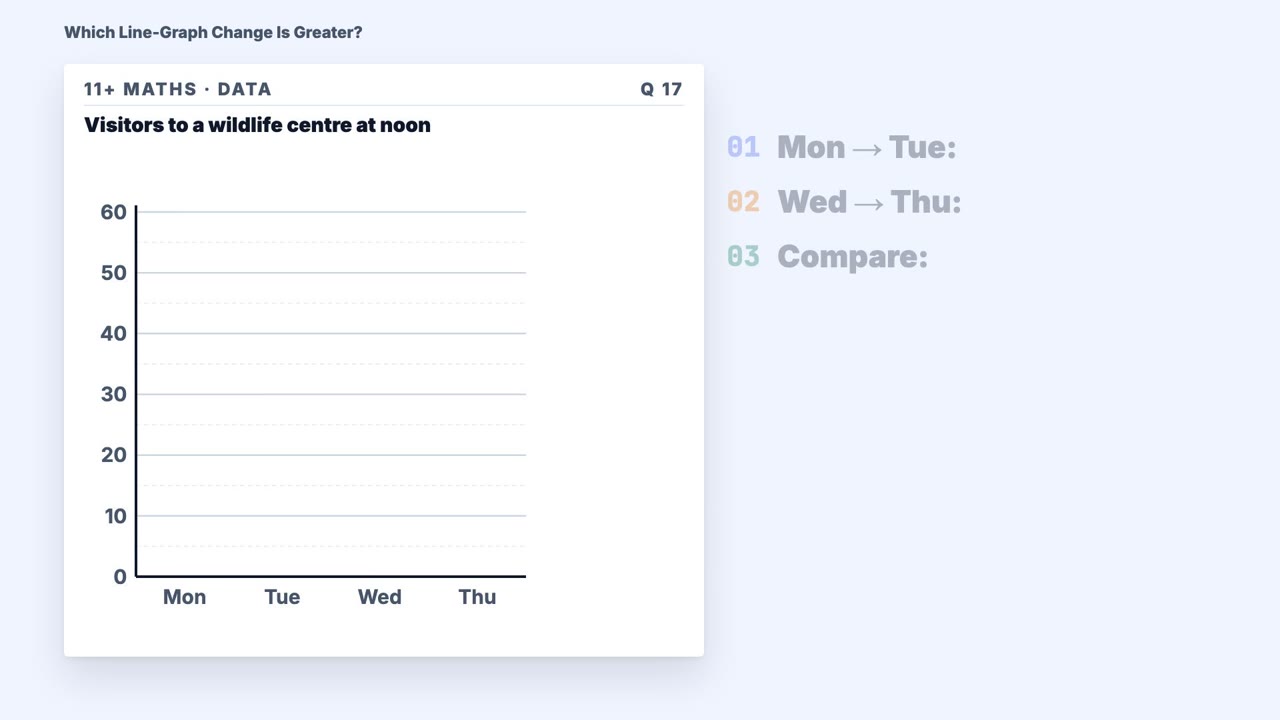
 Length 2:42
Which Line-Graph Change Is Greater?
Compare line-graph change
11+ Maths · Data
A short worked example (2:38) for one 11+ maths skill: Compare bar-chart values.
This video shows how to read two bars using the chart’s scale and compare the quantities they represent. Watch an 11+ maths question solved step by step.
Turn on captions with the CC button. The full transcript is below the video.
Every word of the video, to read along or to skim before watching.
These two bars look almost level. So is the gap one? Not necessarily! A single grid step might mean two, five, or ten. Read the chart carefully... and that tiny-looking gap can reveal a very different answer.
First, find the two named categories along the bottom. Then trace straight up to each bar top. The numbers belong on the value axis at the side. Keep names and numbers in their own lanes, so you never swap a category with a scale value. Next, decode the scale BEFORE reading either bar. Look at two neighbouring labelled lines. If they show zero and two, one grid interval means two units, not one. Count in twos up the side, then read the value level with each bar top. Place the two values in equal-sized cards. The larger value belongs to the taller bar. If the question asks how many more, subtract the smaller value from the larger. That single subtraction gives the gap.
Let's work through an example. A bar chart shows how many pupils chose each activity at a school fair. The value axis runs from zero to twenty pupils, with every grid interval worth two pupils. The skipping bar reaches fourteen. The hoops bar reaches eight. How many more pupils chose skipping than hoops? Find skipping on the bottom axis. Trace upwards to its bar top, then across to fourteen. Now find hoops. Trace upwards, then across to eight. Do not count fourteen squares or eight squares. The scale tells you the values: fourteen pupils and eight pupils. Now compare the two fixed cards: fourteen is greater than eight, so skipping has more. To find how many more, calculate fourteen minus eight. Count on in scale-sized jumps: eight, ten, twelve, fourteen. Three jumps of two make six. So SIX more pupils chose skipping than hoops.
Here is your reliable route: find the categories, decode the scale, read both bar tops, then subtract smaller from larger. Keep the axes straight and trust the labelled scale. You can crack every bar-chart comparison!
Watch these next. The first ones teach the skills closest to this one.
Length 2:42Compare line-graph change
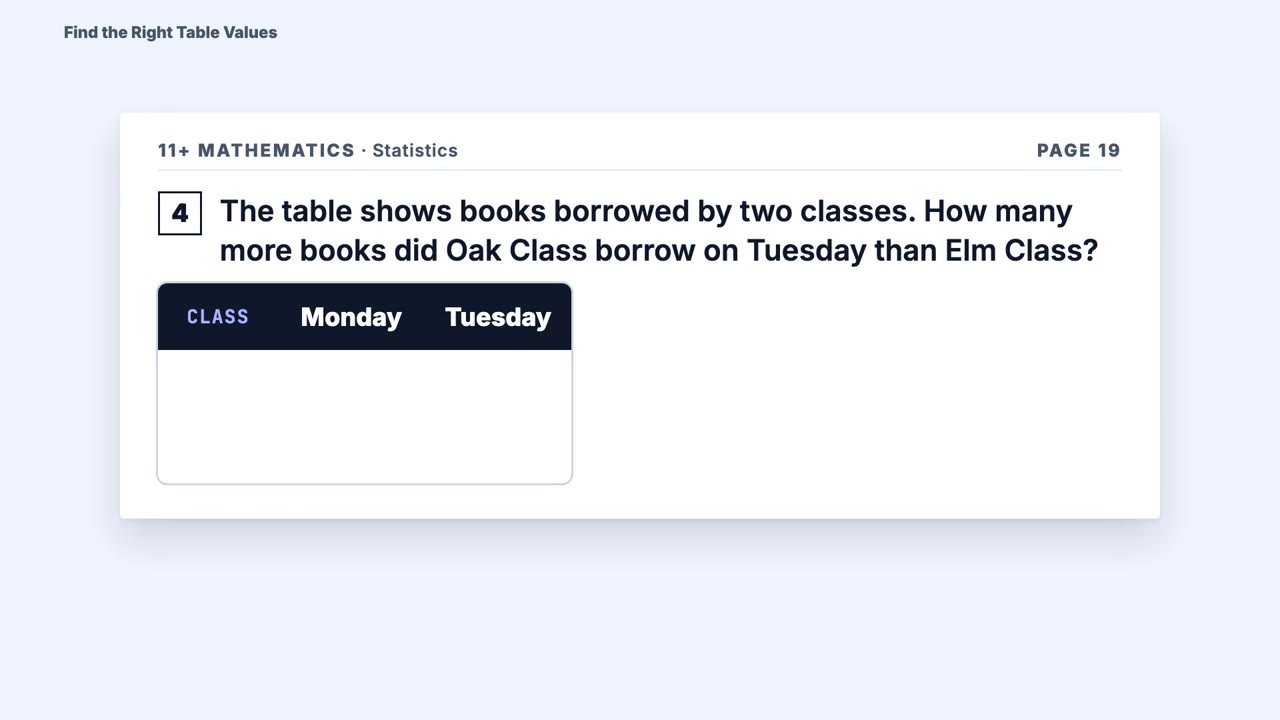 Length 2:38
Compare table values
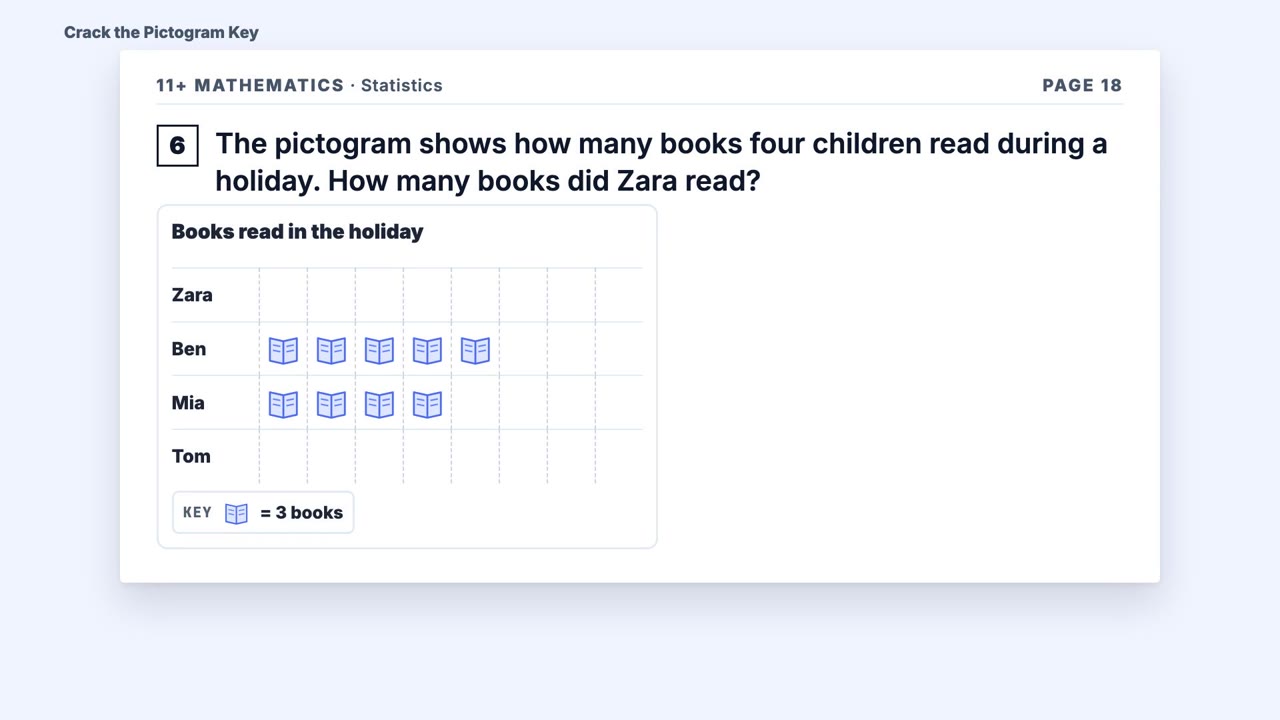 Length 2:34
Decode a pictogram key
The free diagnostic checks maths, English and both kinds of reasoning, and shows what to practise next. No card is required.