
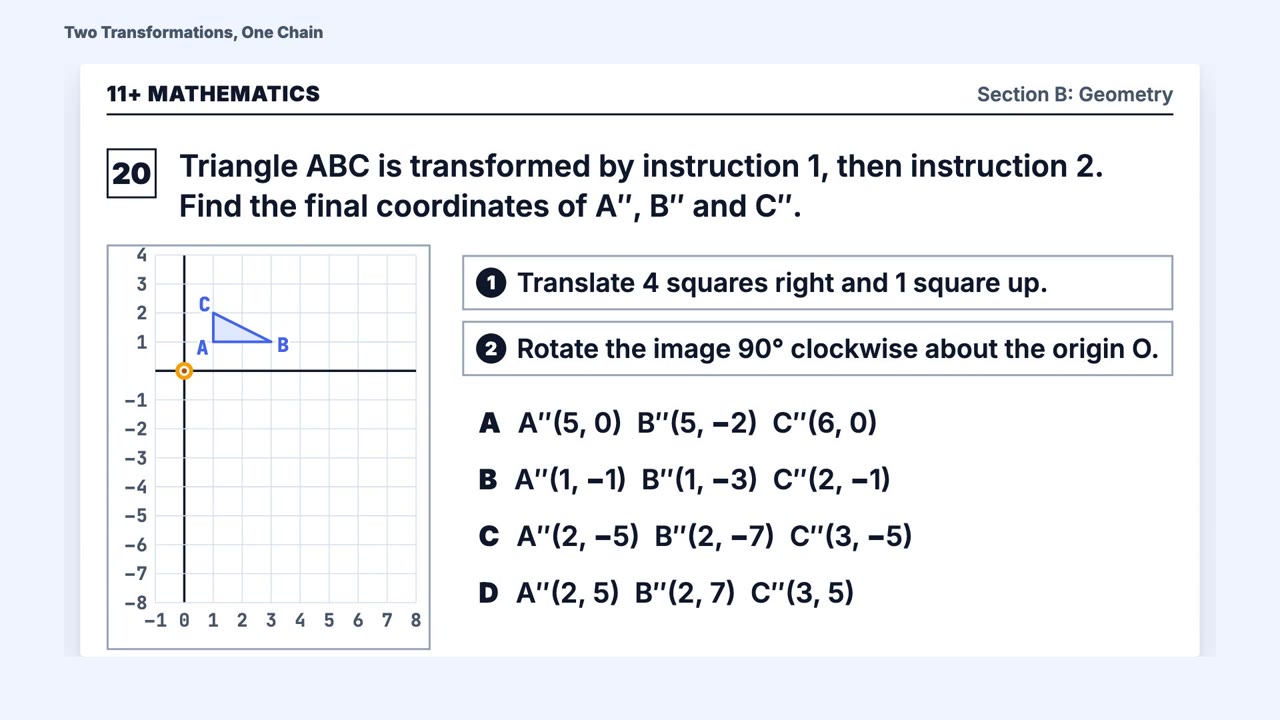
 Length 2:37
Two Transformations, One Chain
Compose coordinate transformations
11+ Maths · Geometry
A short worked example (2:37) for one 11+ maths skill: Classify an angle.
This video shows how to classify an angle by its size and compare it with a right angle or another reference turn. Watch an 11+ maths question solved step by step.
Turn on captions with the CC button. The full transcript is below the video.
Every word of the video, to read along or to skim before watching.
Here is a sneaky angle. Spin it sideways, then upside down... has its name changed? No! The arms point somewhere new, but the opening is identical. An angle is classified by the size of its turn, not its position.
Two arms meet at the vertex. Follow the marked arc from one arm to the other. A narrow gap means a small turn. Lengthen both arms, and the turn stays the same. So watch the GAP between them, never the arm lengths. Use two familiar turns as your benchmarks. One quarter-turn is a right angle, often marked by a small corner square. Less than that is acute. More than a quarter-turn, but less than a half-turn, is obtuse. Exactly one half-turn is straight. A turn beyond a straight angle, but short of one complete turn, is reflex. Rotating the whole diagram changes nothing. Do not mirror the turn in your head. Trace the marked arc in its shown direction, then compare its opening with the benchmarks.
Let's work through an example. An eleven plus question shows a tilted angle with an amber arc marking the turn. Which label is correct: acute, right, obtuse, straight, or reflex? The diagram gives no degrees, so you must classify it by comparison. First, place a right-angle corner at the vertex. Keep the angle and reference on one shared centre. The amber opening reaches past the corner, so it is greater than a quarter-turn. Cross out acute and right. Next, compare the same marked arc with a straight line through that vertex. The opening stops before the line's far side. It is less than a half-turn, so cross out straight and reflex. It lies between the two benchmarks... the answer is OBTUSE. Notice what solved it: the marked turn was larger than one quarter-turn and smaller than one half-turn. Its sloping position was only a distraction. We compared sizes; we never calculated an unknown angle.
Follow the marked arc, then test it against a quarter-turn and a half-turn. Ignore the direction of the arms. Size decides the name... you can spot it!
Watch these next. The first ones teach the skills closest to this one.
Length 2:37Compose coordinate transformations
 Length 2:24
Identify a cube net
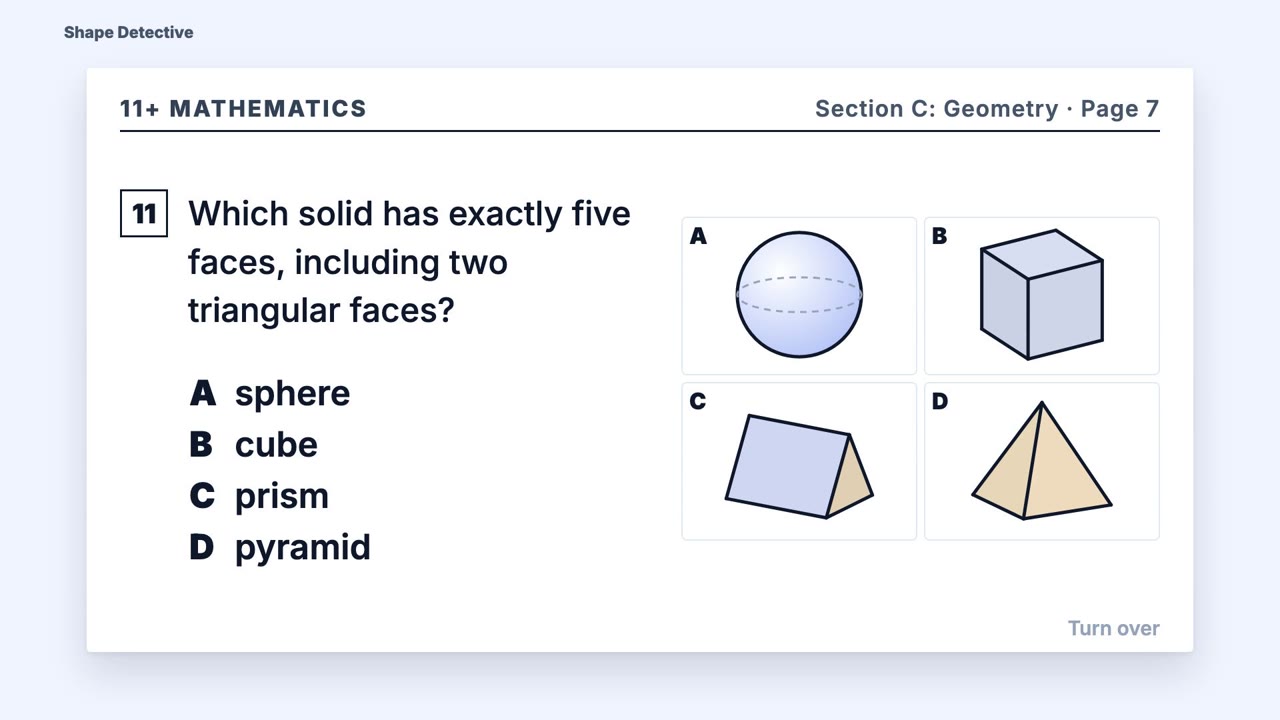 Length 2:38
Identify a shape property
The free diagnostic checks maths, English and both kinds of reasoning, and shows what to practise next. No card is required.