
 Length 2:38
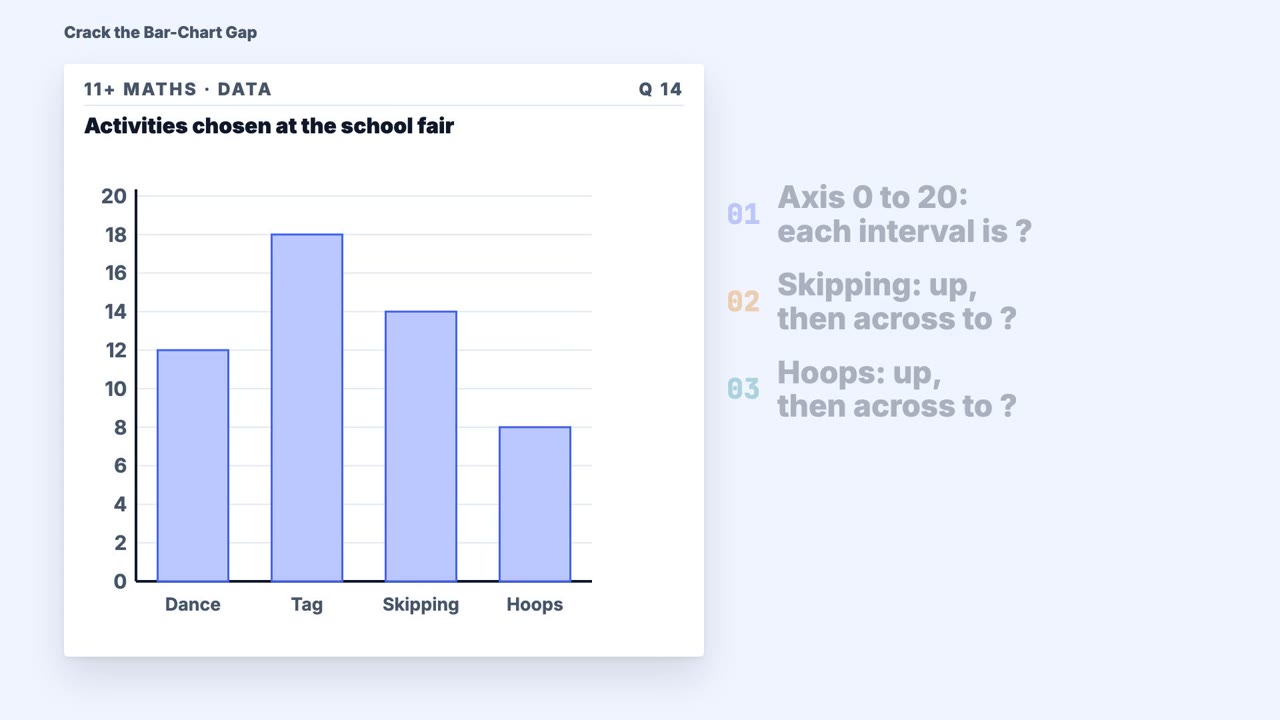
Crack the Bar-Chart Gap
Compare bar-chart values
11+ Maths · Data
A short worked example (2:30) for one 11+ maths skill: Calculate an arithmetic mean.
This video shows how to add a set of values and divide by how many there are to find the mean average. Watch an 11+ maths question solved step by step.
Turn on captions with the CC button. The full transcript is below the video.
Every word of the video, to read along or to skim before watching.
Five friends have different numbers of counters. Yet one number can represent the whole group... without copying any single pile. The secret? Gather them, then share them fairly.
The arithmetic mean is a fair-share number. First, keep every value in a neat line. Add them all to find the total. Watch each card slide into one combined pile, one at a time, so nothing is missed or counted twice. Next, count the VALUES, including repeats. Divide the total by that count. If there are five values, divide by five. Equal piles now settle into the same height. That equal amount is the mean. If symbols supply the data, decode the key first. When one star means two points, three stars mean six points, not three. Change every row into its true value before adding. Count the rows of data, not the symbols.
Let's work through an example. An eleven-plus question shows five players' scores as stars. From top to bottom, the rows contain six, four, five, seven and three stars. The key says one star represents two points. What is the mean score? Decode first. Six stars become twelve points. Four become eight. Five become ten. Seven become fourteen. Three become six. The five score cards stay aligned as twelve, eight, ten, fourteen and six. Now add carefully. Twelve plus eight makes twenty. Add ten to make thirty. Add fourteen to make forty-four. Add six to make FIFTY. That is the total. There are five players, so divide by five... not by the number of stars, and not by the largest score. Fifty divided by five is ten. Ten points appear in each equal share box. So the mean score is ten points. Here, ten happens to be one original score, but a mean does not have to appear in the data.
Add every true value. Count the values. Divide the total by the count. That is the mean: your fair-share number. You can find it!
Watch these next. The first ones teach the skills closest to this one.
Length 2:38Compare bar-chart values
 Length 2:42
Compare line-graph change
 Length 2:38
Compare table values
The free diagnostic checks maths, English and both kinds of reasoning, and shows what to practise next. No card is required.