
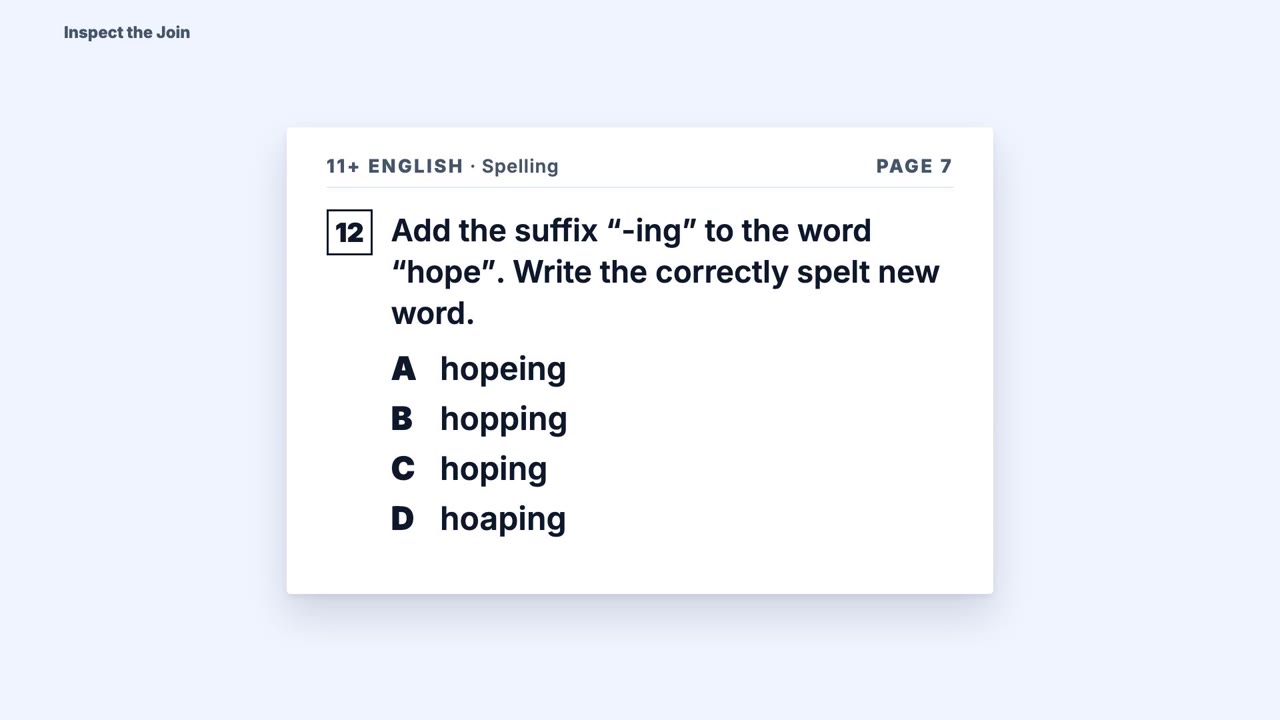
 Length 2:36
Inspect the Join
Apply a prefix or suffix
11+ English · Spelling
A short worked example (2:35) for one 11+ English skill: Resolve an irregular spelling.
This video shows how to choose the correct spelling of words that cannot be spelt by a simple sound rule alone. Watch an 11+ English question solved step by step.
Turn on captions with the CC button. The full transcript is below the video.
Every word of the video, to read along or to skim before watching.
Two spellings can sound exactly the same... yet only one earns the mark. When sound stops helping, how can you choose? You turn the word into something your eyes and memory can check.
First, say the whole word and look at every letter. Sound is a useful starting point, but it cannot always tell you which vowel to write, or whether a consonant appears once or twice. So do not invent a spelling by sound alone. Next, compare the choices in small chunks. Circle the part that changes. Keep any part that you know is fixed. Then use a stored pattern, a word family, or a memory cue to test the uncertain letters. For the word necessary, a handy picture gives one collar and two sleeves: one c, then two s letters. The picture does not explain what the word means. It simply pins down the conventional letter pattern.
Let's work through an example. In the sentence, "It is blank to bring a pencil," which spelling correctly replaces blank? The options are: necessary, neccessary, necesary, and necessery. Start with the sound: NEC-uh-ser-ee. That helps us recognise the target word, but all four options could tempt your ear. Now compare the letters. The ending a-r-y is fixed in the first three choices, while the fourth has e-r-y. Recall the stored ending: a-r-y. Cross out "necessery". Three remain. Check the middle with the memory picture: one collar, two sleeves. One collar means one c. That removes "neccessary", which has two c letters. Two sleeves means two s letters. That removes "necesary", which has only one s. Only "necessary" remains: n-e-c-e-s-s-a-r-y. Put it into the sentence: "It is necessary to bring a pencil." The explicit answer is "necessary" - one c, two s letters, and a-r-y at the end.
When a sound rule cannot decide, compare the changing letters, recall the stored pattern, and check the whole word. Trust sound to begin... then trust careful recall to finish. You can crack the irregular spelling!
Watch these next. The first ones teach the skills closest to this one.
Length 2:36Apply a prefix or suffix
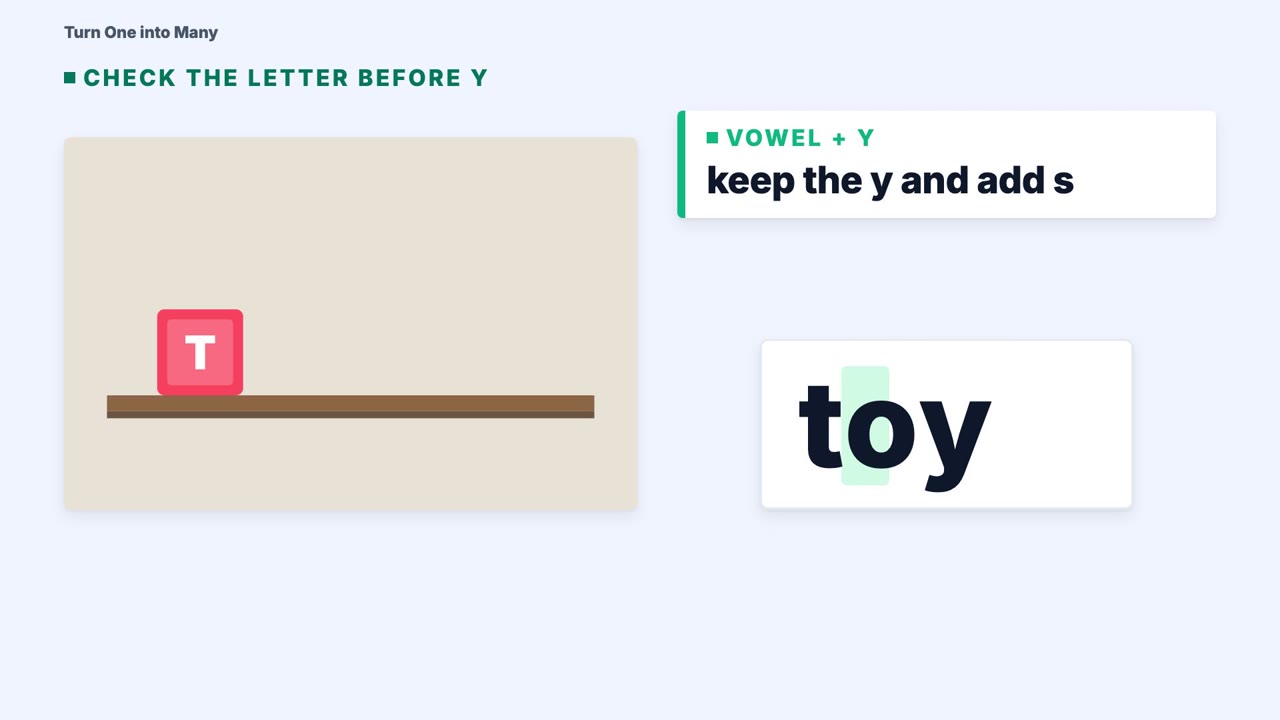 Length 2:23
Form a plural
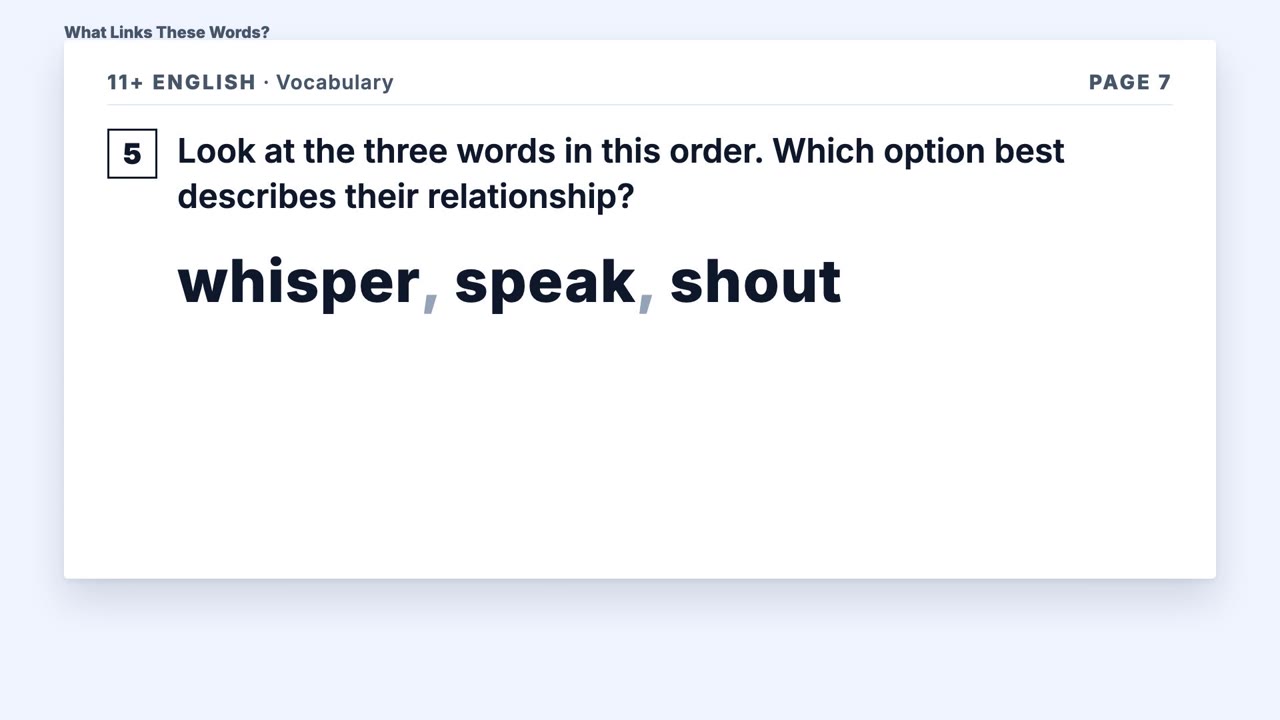 Length 2:40
Classify a word relationship
The free diagnostic checks maths, English and both kinds of reasoning, and shows what to practise next. No card is required.