
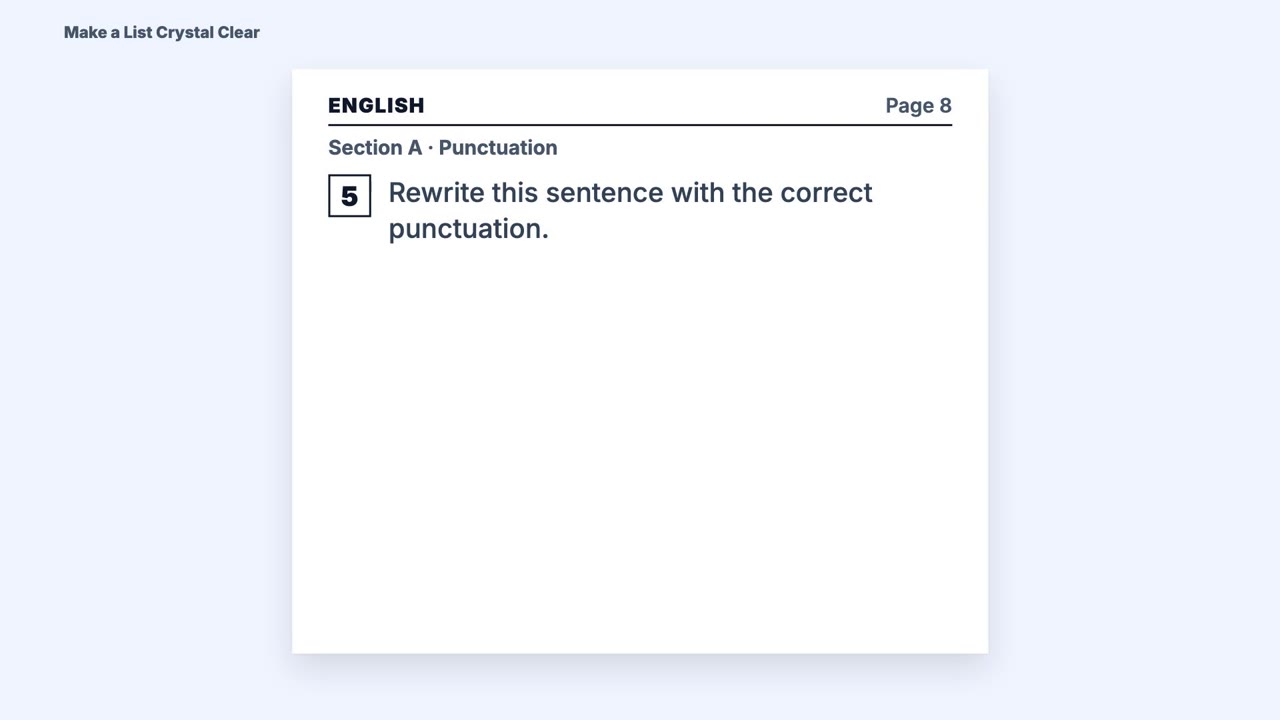
 Length 2:35
Make a List Crystal Clear
Punctuate a list
11+ English · Punctuation
A short worked example (2:45) for one 11+ English skill: Punctuate a fronted adverbial.
This video shows how to find the fronted adverbial and place the comma that separates it from the main clause. Watch an 11+ English question solved step by step.
Turn on captions with the CC button. The full transcript is below the video.
Every word of the video, to read along or to skim before watching.
One tiny mark can stop a reader racing into the wrong meaning. Put it after the opening detail, and the sentence suddenly clicks. But which opening words need that comma? Watch the sentence unlock... right at the front.
A fronted adverbial comes before the main clause. It tells you more about when, where, how, or why something happens. 'Before sunrise' answers when. 'Without a sound' answers how. These opening chunks set the scene. Now find the main clause: 'the fox slipped beneath the gate.' It can stand alone and gives the central action. The opening chunk cannot do that job here. So place a comma at the join: 'Before sunrise, the fox slipped beneath the gate.' The comma pauses between the scene-setting opener and main clause. Do not confuse this comma with an apostrophe. An apostrophe can show missing letters in a contraction, such as 'it's' for 'it is', or show possession, as in 'the fox's tail'. That mark sits inside or beside a word. Our comma sits after the whole fronted adverbial. Different marks. Different jobs.
Let's work through an example. Here is the complete question. Add one comma to this sentence: 'After the final whistle the excited players raced onto the pitch.' Keep every word in the same order. Your task is to choose exactly where it belongs. First, find the central action. 'The excited players raced onto the pitch' makes sense by itself. That is the main clause. Next, inspect the words before it: 'After the final whistle.' They tell us WHEN the racing happened. So that whole opening phrase is the fronted adverbial. Place the comma straight after 'whistle'. The finished sentence is: 'After the final whistle, the excited players raced onto the pitch.' Check it. The scene-setting opener ends, the comma marks the join, and the main clause begins with 'the'. No apostrophe is needed: there is no contraction or possession. Answer confirmed.
Find where the fronted adverbial ends, then place a comma before the main clause. Spot that join... and every scene-setting opener becomes clear. You've got this!
Watch these next. The first ones teach the skills closest to this one.
Length 2:35Punctuate a list
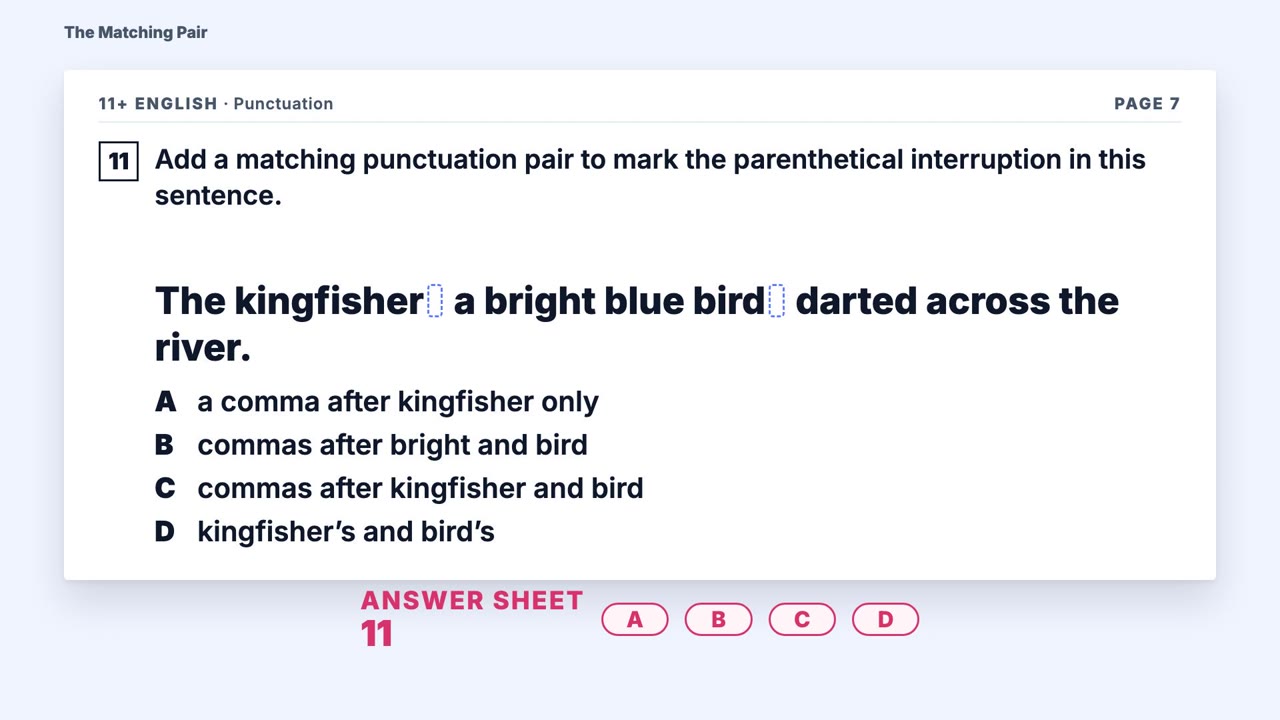 Length 2:48
Punctuate parenthesis
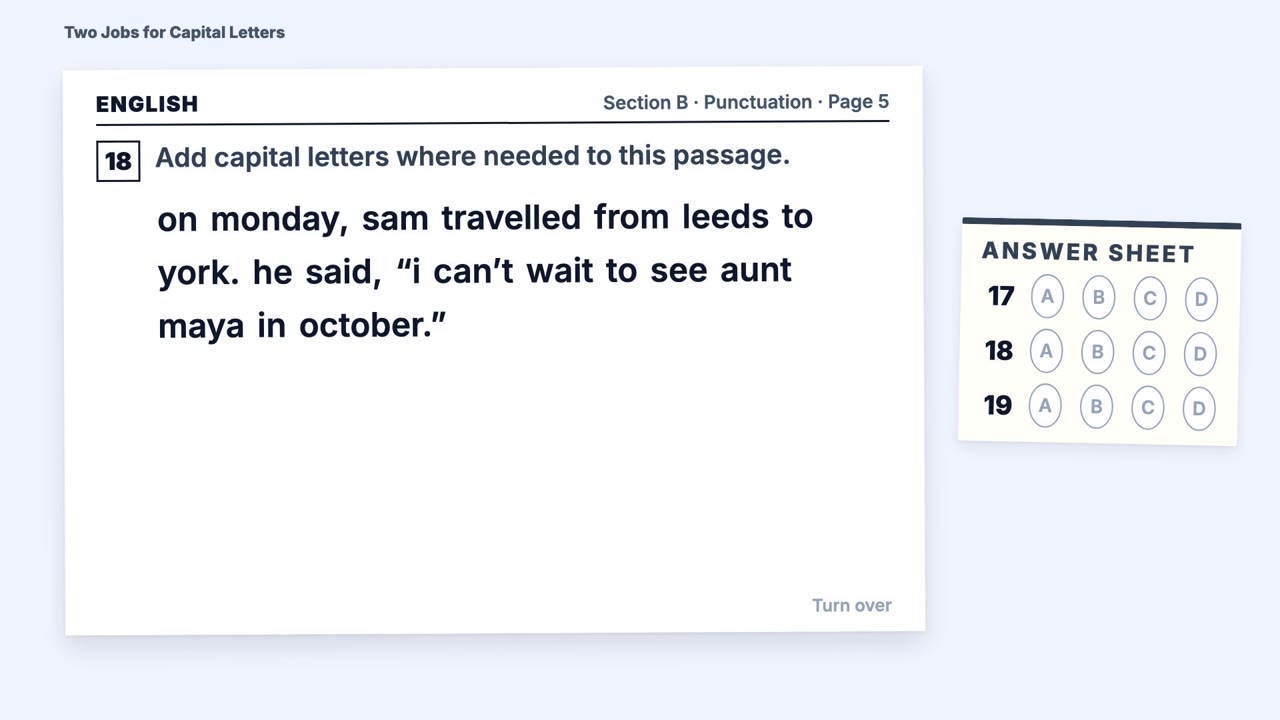 Length 2:33
Use capital letters
The free diagnostic checks maths, English and both kinds of reasoning, and shows what to practise next. No card is required.