
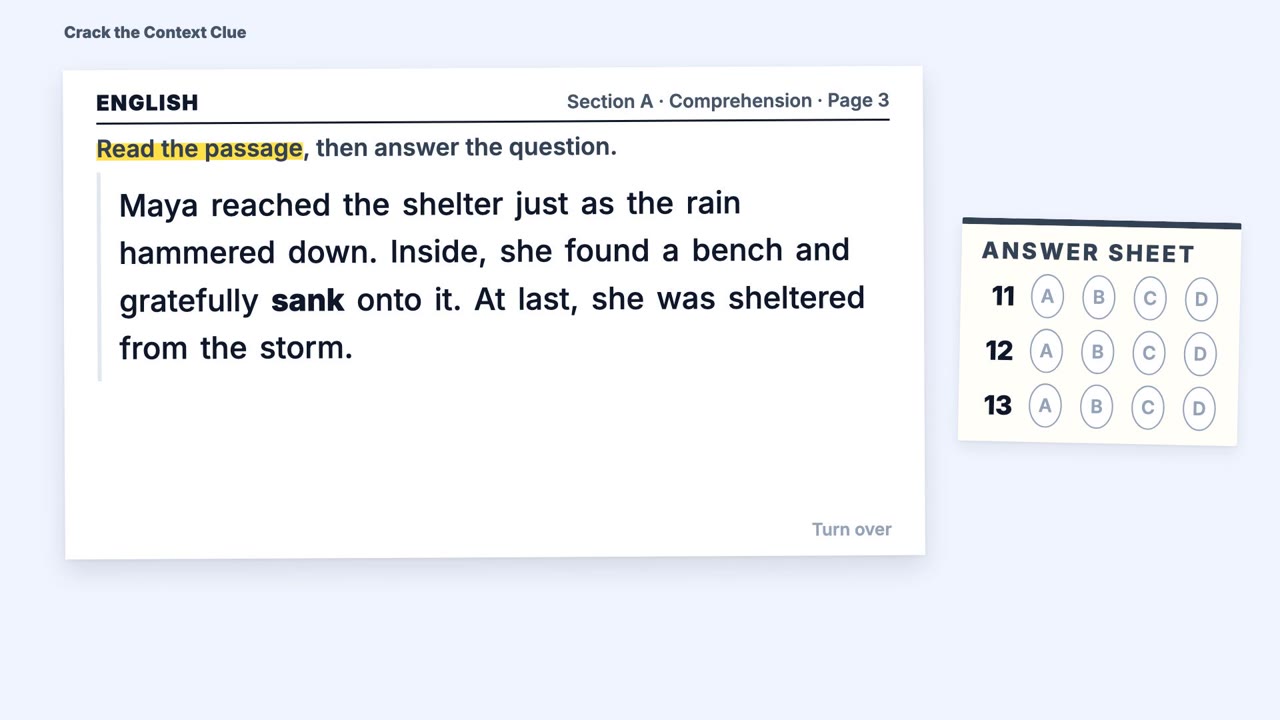
 Length 2:33
Crack the Context Clue
Interpret a word in context
11+ English · Reading
A short worked example (2:37) for one 11+ English skill: Infer implicit meaning.
This video shows how to use evidence in a passage to draw a conclusion that the writer has not stated directly. Watch an 11+ English question solved step by step.
Turn on captions with the CC button. The full transcript is below the video.
Every word of the video, to read along or to skim before watching.
A character shuts a window, pulls on a jumper, and rubs their hands. Nobody says the room is cold. Yet you know it. How? The writer has left clues, and your brain has joined them together.
An inference is one supported conclusion that the text does not state directly. Think of it as a bridge. On one side are the writer's exact clues. On the other side is your conclusion. Every plank must come from the text. Use three steps. First, spot the useful details. Next, ask what those details suggest together. Then, state one careful conclusion. Say, "This suggests..." rather than inventing a whole new story. Watch out for a tempting trap. A nearby detail may be true, but merely copying it is not an inference. And a guess can sound sensible yet still be unsupported. Point to the words that prove your idea.
Let's work through an example. Read this passage: "Maya checked the hall clock again. She placed her packed rucksack beside the front door, then peered through the rain-speckled glass. When headlights swept across the wall, she sprang up and grabbed the handle." What can you infer about Maya? Start with the exact clues. Maya checks the clock AGAIN. Her rucksack is already packed. It is waiting by the door. She watches outside, then moves quickly when headlights appear. Highlight those four details. Now join them. Repeated clock-checking suggests she is waiting for a particular time. The packed bag and position by the door suggest she plans to leave. Her quick reaction to the headlights suggests the expected person or vehicle has arrived. So the supported answer is: Maya is eagerly waiting to be collected for a trip. Notice the limit. We cannot claim where she is going, or who is collecting her. The passage gives no evidence for either detail.
Remember: find the clues, join them, and make ONE conclusion that every clue supports. If you can point to the evidence and avoid adding extras, you have read between the lines brilliantly.
Watch these next. The first ones teach the skills closest to this one.
Length 2:33Interpret a word in context
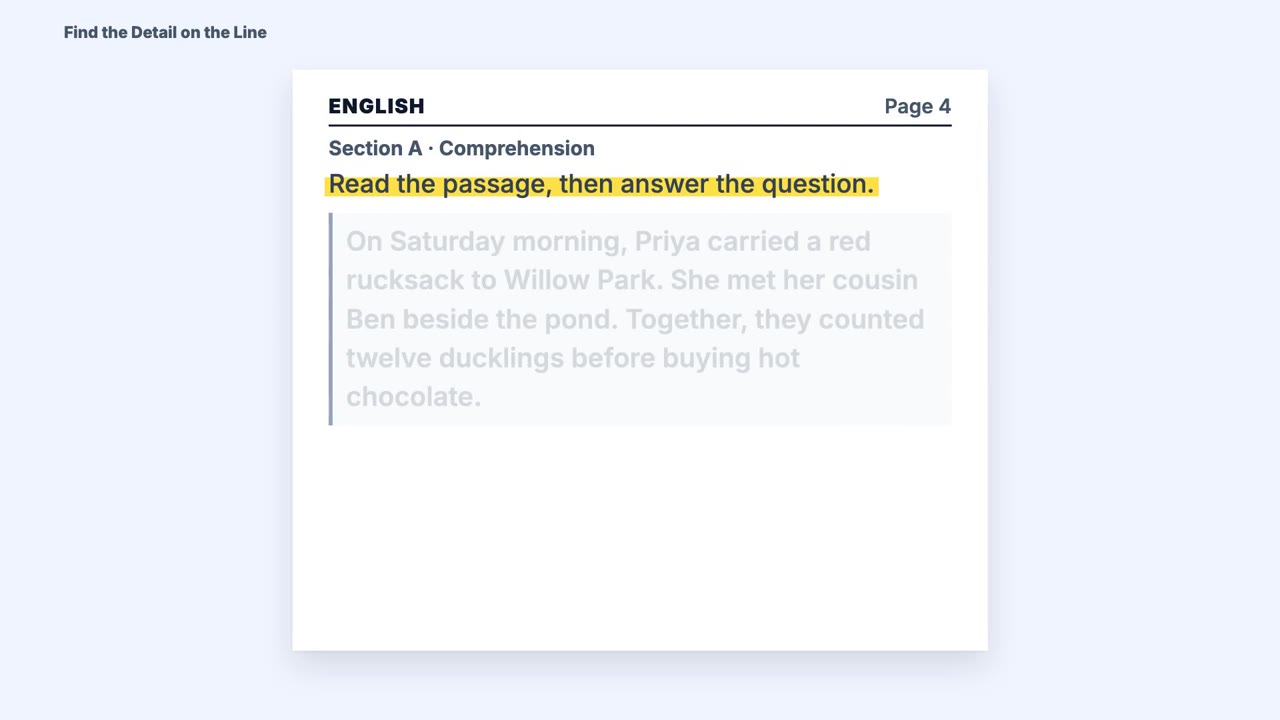 Length 2:35
Retrieve an explicit detail
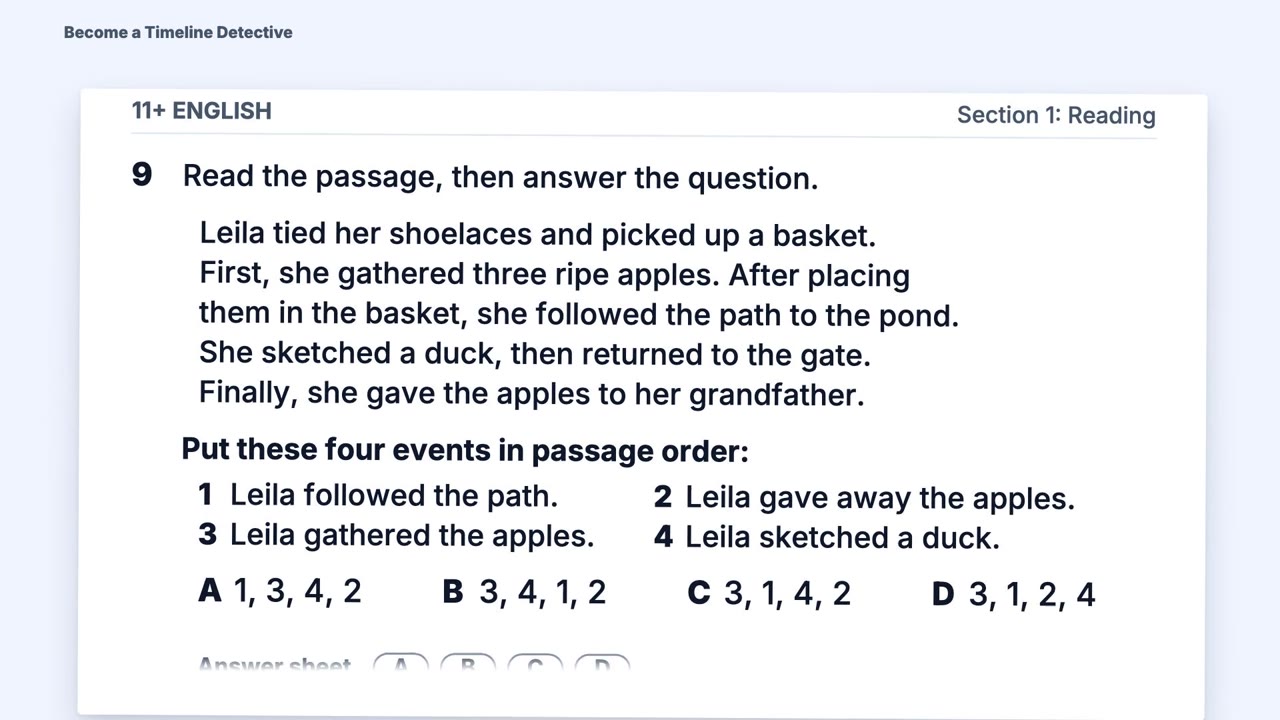 Length 2:43
Sequence passage events
The free diagnostic checks maths, English and both kinds of reasoning, and shows what to practise next. No card is required.