
 Length 2:37
Read Between the Lines
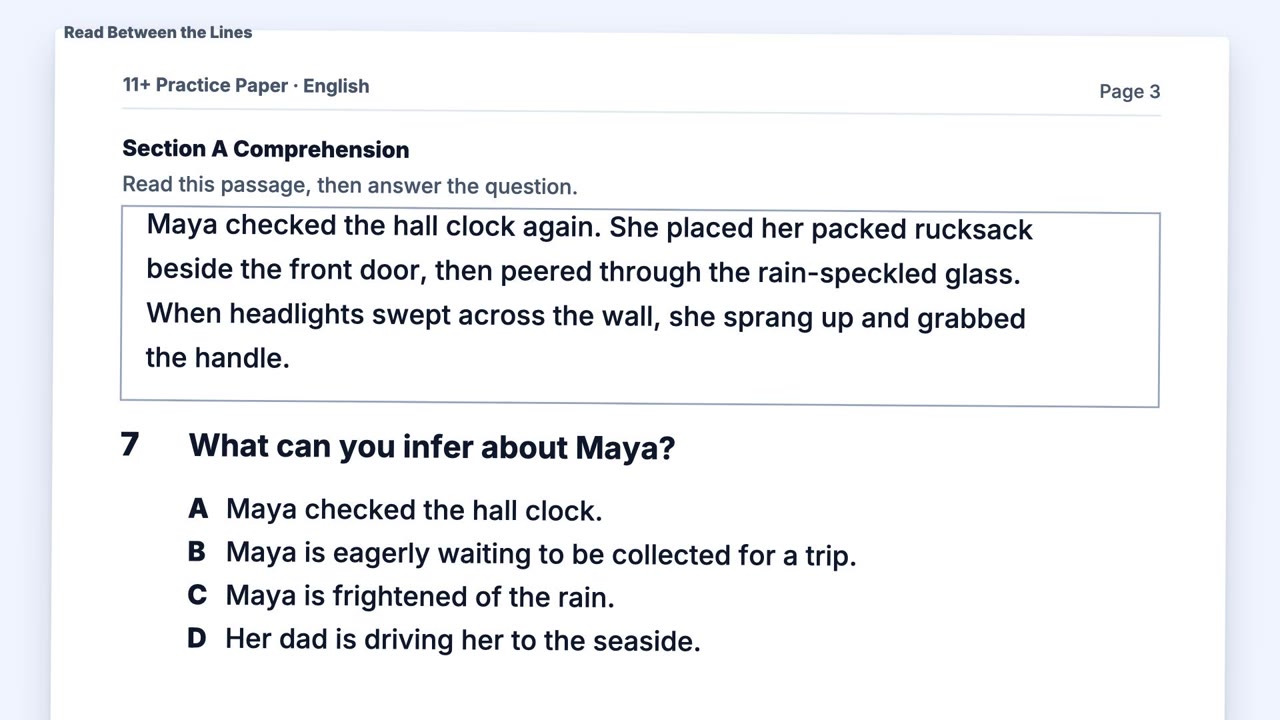
Infer implicit meaning
11+ English · Reading
A short worked example (2:33) for one 11+ English skill: Infer a character state.
This video shows how to use details in a text to infer a character’s feelings, motives or attitude. Watch an 11+ English question solved step by step.
Turn on captions with the CC button. The full transcript is below the video.
Every word of the video, to read along or to skim before watching.
A character can say almost nothing, yet still reveal exactly how they feel. The secret is not guessing. It is spotting the tiny clue that turns a possible feeling into a supported inference.
An inference is an idea the writer leaves for you to work out. First, look closely at what the character says or does. You might see a clenched fist, a whispered answer, or a glance towards the door. Those are evidence clues. Ask: what feeling, motive, or attitude BEST explains this exact detail? Now build a quick evidence bridge. On the left is the written clue. On the right is one inference. The bridge only stands if the clue supports the idea. Do not choose a nearby detail just because it sounds useful. Do not choose a likely feeling with no proof. Point to the stated words, then explain the link.
Let's work through an example. Read this complete question. 'Mina folded the invitation into a neat square and slid it beneath her book. When Zoe asked whether she was coming to the party, Mina studied her shoelaces and said, "I might be busy." What does Mina's behaviour suggest about how she feels? Use evidence from the passage.' Start with the exact evidence. Mina hides the invitation beneath her book. Then she avoids Zoe's gaze by studying her shoelaces. Her words, 'I might be busy,' are uncertain. These clues belong together. She does not proudly refuse, and the text never says that she dislikes parties. So, what single state fits all three clues? Mina feels uncomfortable about admitting that she may not attend. The strongest answer is: Mina feels uncomfortable about telling Zoe she might not come. We can support it clearly - she hides the invitation, looks down, and gives a hesitant reply. That is evidence, then inference.
Remember: choose one character state, find the exact words that support it, and explain the connection so your evidence bridge stands. You are ready to read between the lines!
Watch these next. The first ones teach the skills closest to this one.
Length 2:37Infer implicit meaning
 Length 2:33
Interpret a word in context
 Length 2:35
Retrieve an explicit detail
The free diagnostic checks maths, English and both kinds of reasoning, and shows what to practise next. No card is required.