
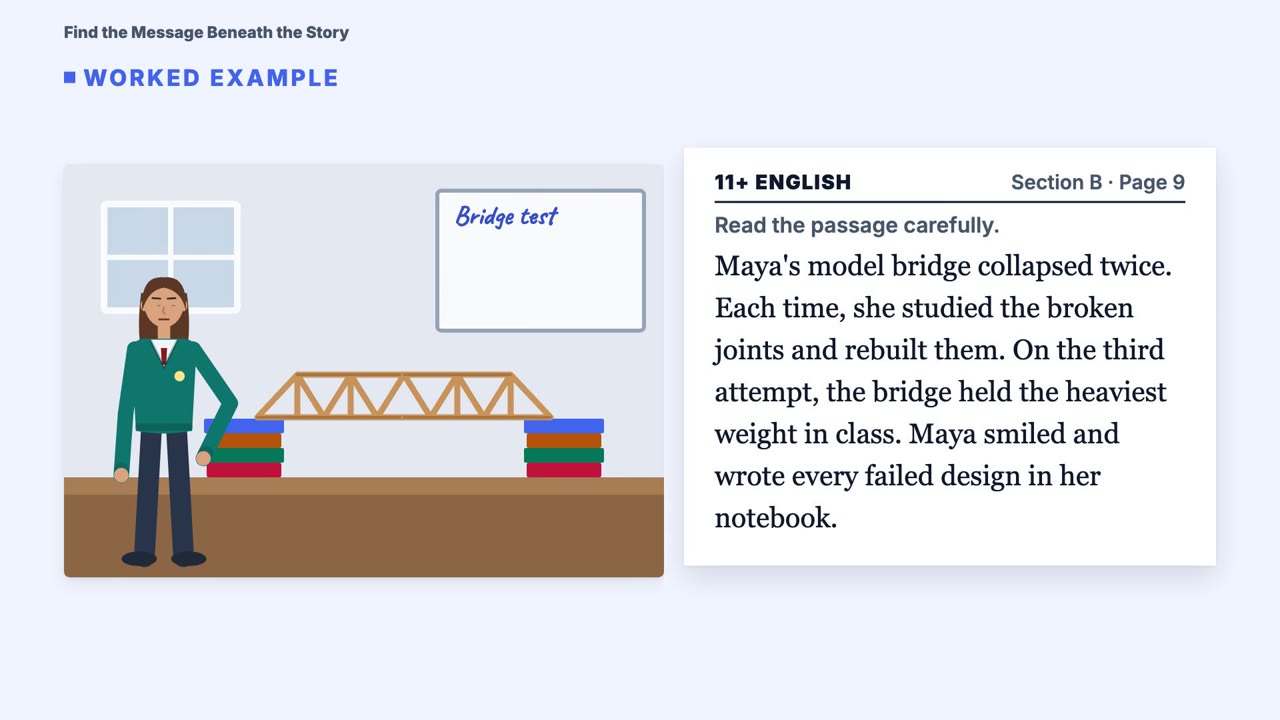
 Length 2:44
Find the Message Beneath the Story
Identify a theme
11+ English · Reading
A short worked example (2:42) for one 11+ English skill: Identify writer purpose.
This video shows how to work out why a text was written by checking what the writer wants it to do. Watch an 11+ English question solved step by step.
Turn on captions with the CC button. The full transcript is below the video.
Every word of the video, to read along or to skim before watching.
Two texts can mention exactly the same storm, yet be written for completely different reasons. One might warn you. Another might entertain you. So how do you spot the writer's real purpose... without being distracted by an exciting detail?
Start with the whole text or section. Ask, "What is the writer trying to make me know, feel, or do?" Writers may explain facts, persuade you, describe something, entertain you, give instructions, or warn you. The purpose is the job the words are doing - not simply the topic they mention. Next, hunt for evidence. Circle revealing verbs, repeated ideas, and the way the writer addresses the reader. "Mix the flour" points towards instructions. "You must protect our park" points towards persuasion. But stay precise. A dramatic detail can be nearby without being the main purpose, and a clever guess is not enough unless the words support it. Use a simple evidence frame: "The writer's purpose is to..., because the text says..." Choose a purpose verb that fits the entire section. Do not grab a familiar definition if it clashes with the sentence in front of you.
Let's work through an example. Read this complete 11+ style question: "School gardens give pupils a quiet place to read and study. They also attract insects and help children learn where food comes from. Every school should create one, even if it begins with just a few pots." Why was this paragraph written? A: to give gardening instructions. B: to persuade schools to create gardens. C: to describe a frightening insect. D: to entertain with a funny story. First, check the evidence. The benefits build a positive case: quiet reading, insects, and learning about food. Then the command appears: "Every school should create one." The writer wants schools to ACT. So B is correct: the paragraph was written to persuade schools to create gardens. The insects are only a supporting detail, not the purpose.
When you identify purpose, name the writer's job and prove it with exact words. Topic plus evidence... and you've cracked it!
Watch these next. The first ones teach the skills closest to this one.
Length 2:44Identify a theme
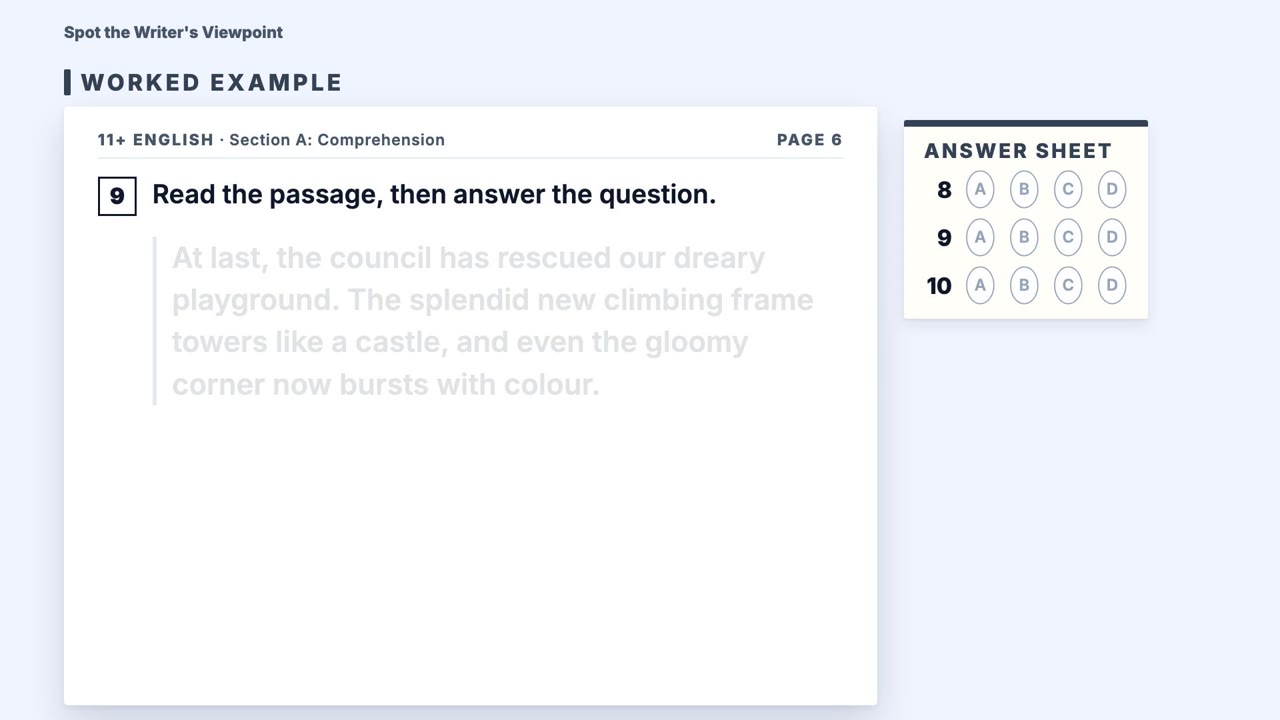 Length 2:55
Identify writer viewpoint
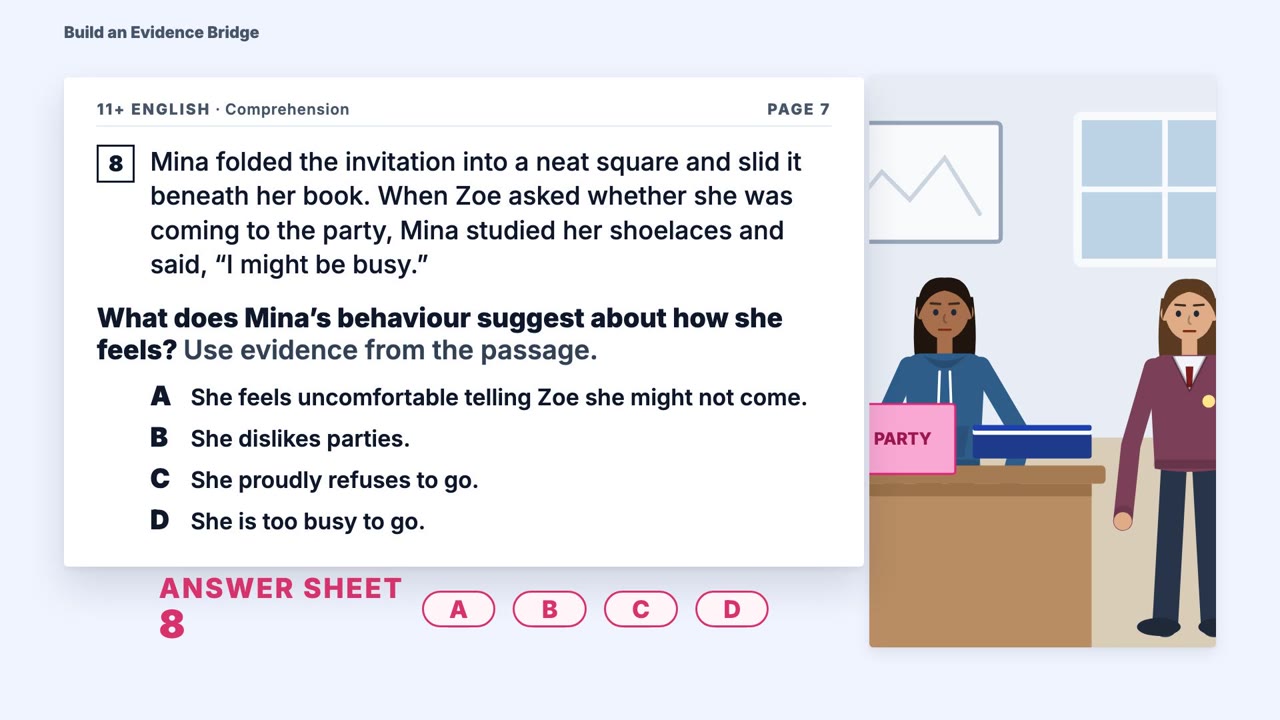 Length 2:33
Infer a character state
The free diagnostic checks maths, English and both kinds of reasoning, and shows what to practise next. No card is required.