
11 Plus Results Day: Understanding the Letter and Your Options
A region-by-region guide to 11 plus results dates and qualifying scores, and the full sequence from the results letter to the 31 October application deadline, National Offer Day and grammar school appeals.
 Elspeth Marlow10 min read
The results email arrives in October, and it usually contains several scores plus a decision about selective suitability. Almost every page a parent finds that day is a council page, and a council page can only tell you one region's date and one region's threshold. It cannot tell you whether your child's number is comfortable or borderline, what the next four months look like, or which of the two completely different challenge processes applies to you.
That gap matters because the clock is genuinely short. Results land in mid-October, the common application form (CAF) for secondary school is due on 31 October, and most families therefore have around two weeks to convert a score into a considered list of preferences. The decisions made in that fortnight determine which schools can refuse an on-time application on National Offer Day, and therefore which appeals can begin promptly in March.
This guide picks up where our overview of how the 11 plus exam works leaves off, and covers the whole sequence in one place: dates and thresholds across the main selective areas, what each number in the letter means, what to do if the score qualified, fell short or landed on the borderline, and how grammar school appeals actually work once National Offer Day has passed.
When 11 plus results day falls, and how the result reaches you
Most selective areas release results by mid-October, and almost all of them do it by email rather than by post. Here is the picture for 2027 entry, with the caveat that every authority publishes its own confirmed date each summer and you should check the source link before relying on a date.
- Kent: results emailed on Thursday 15 October 2026 to the address used at registration. Families who gave no email address get a first class letter on results day, and can ask the child's primary school for the scores the day after (Kent County Council).
- Buckinghamshire: Secondary Transfer Test results emailed after 4pm on 9 October 2026 (Buckinghamshire Council).
- Medway: Medway Test results emailed after 10am on Wednesday 14 October 2026, posted the same day where no email address was registered (Medway Council).
- Warwickshire: results published via the Parent Portal on 16 October 2026, after tests on 12 and 13 September 2026 (Warwickshire County Council).
- Bexley: results by email in early October 2026, with the exact date still to be confirmed. The result is a weighted age-standardised score built around a scale centred on 200 (London Borough of Bexley).
- Redbridge: results emailed in mid-October after a test provided by GL Assessment (London Borough of Redbridge).
The important shared feature is that every one of these dates sits inside the same three-week window before 31 October. Wherever you are, the answer to "what date do 11+ results come out" is mid-October, and the answer to "how long do I have" is about a fortnight.
What the numbers in the letter mean
A typical letter gives you a standardised score per paper, a total, and a suitability decision. In Kent, children receive three standardised scores (English, maths and reasoning) plus a total, and each individual score falls between 69 and 141, so the highest possible total is 423. Medway's notification gives the total, a breakdown per paper, a decision on suitability for a grammar or non-grammar school, and next steps.
The raw marks are not usually shown, and that is deliberate. Standardisation, as Kent describes it, is "a statistical process which compares your child's performance with the average performance of other children in each test", with "a slight adjustment made to take account of each child's age so that the youngest are not at a disadvantage". A September-born and an August-born child with identical raw marks will not necessarily receive identical standardised scores because the comparison accounts for age.
One warning that applies to every area: a suitability assessment is not an offer. Medway states plainly that being assessed as suitable "does not guarantee them a grammar school place". Suitability gets your child into the queue; oversubscription criteria decide who gets a seat.
Myth: a standardised score is always out of 100
Reality: the scale depends entirely on the area, and assuming 100 is average will make you misread your own child's letter. Most published "standardised score tables" centre on 100 because that is the convention GL Assessment uses for a single paper, but the number your council reports may be a total or a weighted average on a different scale.
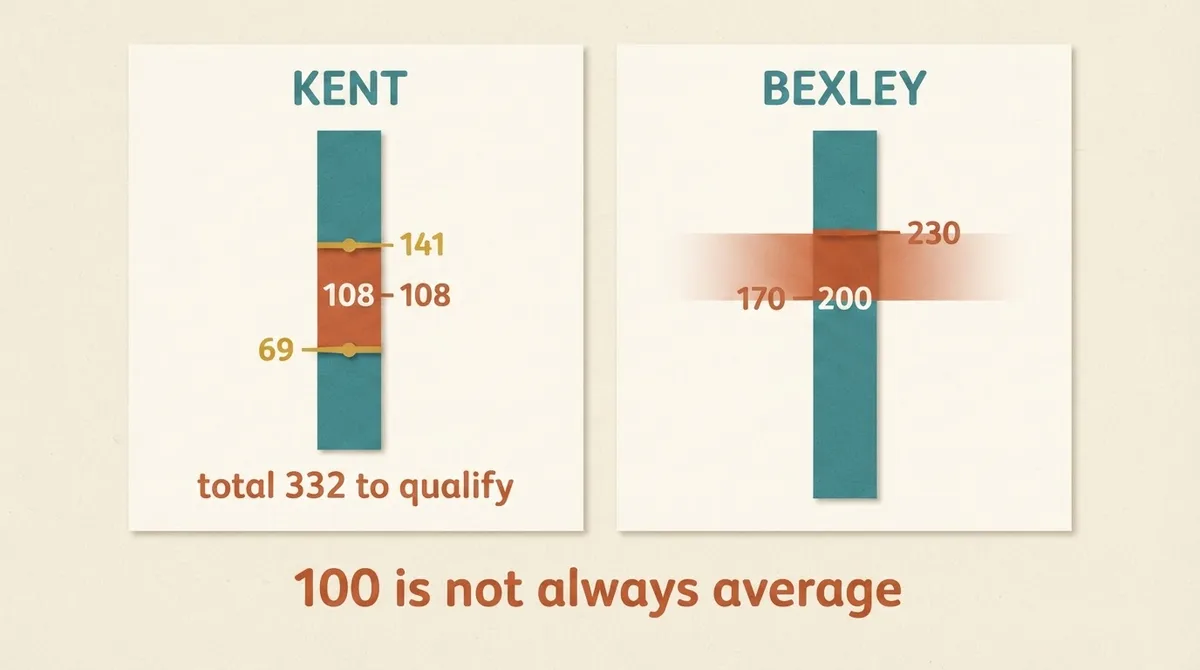
The published thresholds show how far apart these systems are:
- Kent (2025 test): a grammar assessment required a total of 332 or more with no single score lower than 108. The 2026 threshold is published in October 2026.
- Buckinghamshire: a standardised score of at least 121 makes a child eligible for a grammar school place. Below 121 a child is usually not eligible, but can still reach a grammar school through a successful Selection Review, a successful admission appeal, or Pupil Premium eligibility.
- Bexley: a weighted average built around 200, with roughly two-thirds of children scoring somewhere between 170 and 230.
So a score of 121 is a qualifying result in Buckinghamshire and a meaningless number in Bexley. Kent's rule adds a second trap: a child can clear 332 in total and still be assessed as unsuitable because one paper dipped below 108. Our grammar school league table puts published school outcomes in context, but it does not replace checking each school's current admissions policy.
Myth: if the score is disappointing, you appeal now
Reality: you cannot appeal a school place in October because an admission appeal challenges a refusal, and no place has yet been refused. Kent puts it directly: a child who was not tested or not assessed as suitable can still be named on the application, and "your application to that school will be refused when school places are offered on 1 March 2027". The right to appeal that refusal arises at that point.
The practical consequence is the single most important thing on this page. If you leave the grammar school off the CAF because the score was low, there is no refusal for that school on National Offer Day, so you cannot start an appeal for it then. You may be able to make a late application and appeal if that application is refused, but this delays the process and the admission authority's late-application rules will apply. Medway describes the on-time sequence: apply by 31 October, receive outcomes on 1 March, then lodge appeals directly with the preferred schools, including an argument that a child should be admitted despite not being assessed as suitable.
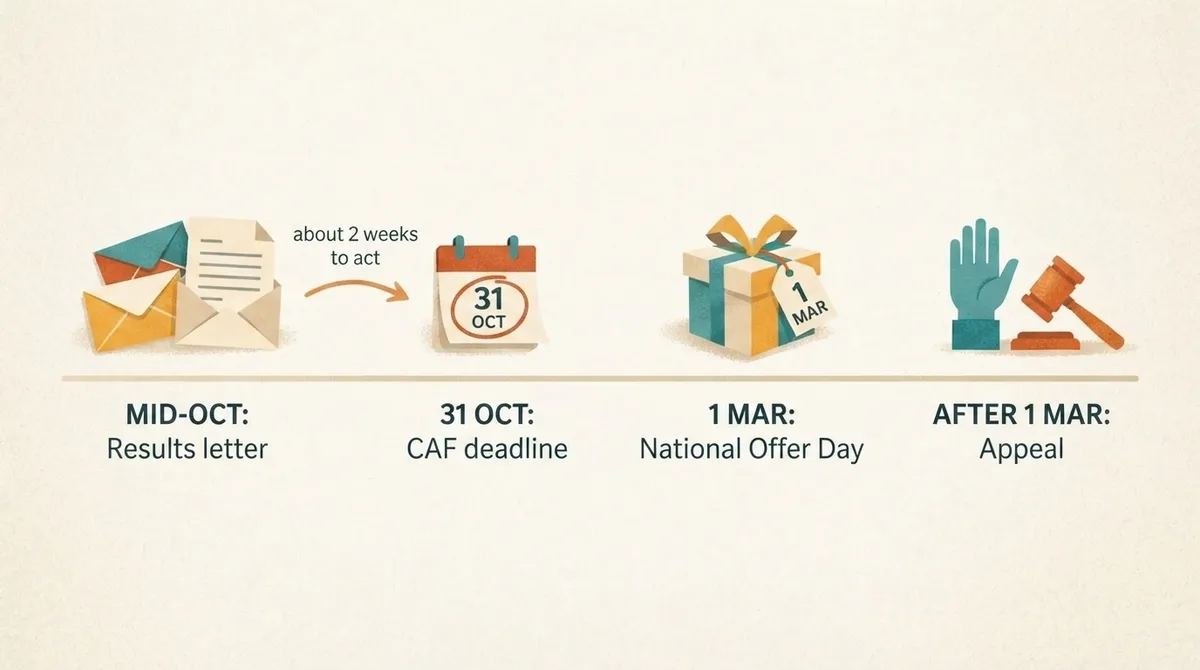
The full sequence, using Warwickshire's published 2027-entry schedule as the template:
- Tests sat in September 2026.
- Results released 16 October 2026.
- Secondary application deadline 31 October 2026.
- Proof of address deadline 31 December 2026.
- National Offer Day 1 March 2027.
- Appeals lodged with the individual schools after 1 March.
If your child qualified: use the two weeks properly
Qualifying is the start of the application, not the end of it. Rank schools in genuine preference order. Schools consider each application against their own admission rules, then your council offers the highest preference for which your child qualifies, so there is no tactical benefit to demoting a first choice. Check each grammar school's oversubscription criteria individually, since catchment, distance, sibling priority and Pupil Premium rules differ between schools in the same county.
Name a realistic non-selective school too. A CAF listing only grammar schools can leave a qualified child allocated to whichever school has space in March. If you are weighing up how competitive a score is against a school's historic entry point, our regional guides set out which test each area uses and how places are allocated.
If the score is borderline: reviews are an autumn process
A Selection Review or Headteacher Review is not an appeal, and confusing the two costs families deadlines. Reviews happen in the autumn, are run by the local authority or the school's own panel, and reconsider whether a child of grammar ability underperformed on the day. Appeals happen from March, are heard by an independent panel, and challenge a refusal of a place.
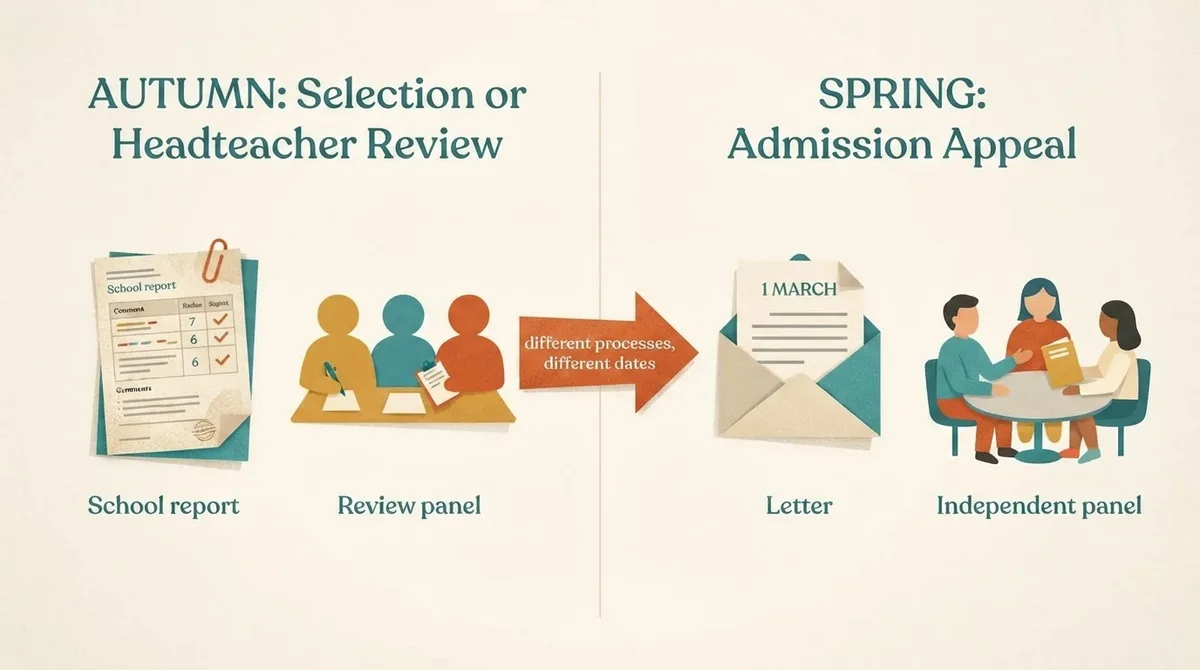
Review panels want school evidence, not test practice: reports, teacher assessment data, headteacher comment. Buckinghamshire's guidance on the related appeal stage is instructive about what convinces a panel anywhere, asking for evidence a child sits "in the top third of the academic cohort" through school reports, SATs results and headteacher letters, and advising parents not to submit samples of schoolwork.
Reviews exist in some areas and not others, so check your own authority's page before assuming one is available. Buckinghamshire offers a parent-requested Selection Review after results. Bexley's Headteacher Review takes place after results and after the secondary application deadline. Kent's Headteacher Assessment is different again: a primary headteacher can refer a result before the parent receives the decision. Each process has its own eligibility rules and deadline.
Myth: around 30% of grammar school appeals succeed
Reality: Buckinghamshire's published current figures are far lower. In 2025, 7% of qualified grammar school appeals and 2% of unqualified appeals succeeded (Buckinghamshire Council). Other areas and individual schools publish different figures, or none at all.
The reason unqualified appeals are so much harder is the two-stage test. The panel must first decide whether the Selection Review "was carried out in a fair, consistent and objective way", and can only proceed if the review was not processed correctly. Only then does it weigh "strong, written academic evidence of grammar school ability" alongside "exceptional social, medical or educational reasons" for that particular school.
What you are guaranteed is process, not outcome. Under gov.uk admission appeal rules you get at least 20 school days to appeal from the date the decision letter is sent, at least 10 school days' notice of the hearing, and the decision usually within 5 school days. The panel has three or more independent members, and must uphold the appeal if the admission criteria were not properly followed, or if your reasons outweigh the school's reasons for refusing.
Waiting lists, and the child in front of you
Join the waiting list for any refused school even while appealing, since the two run in parallel and lists move through the spring and summer as families decline offers. Waiting lists are ranked by the school's oversubscription criteria, not by date of joining, so a later addition can enter above an earlier one.
Finally, the letter says something about one morning in September, not about your child. Children read parental disappointment quickly and interpret it as a verdict on themselves. Whatever the number, the useful next conversation is about the secondary school they will actually attend and what they want to be good at there. If you are supporting a younger sibling through the same cycle, structured practice with visible progress beats last-minute intensity; our progress tracking shows exactly which topics are still costing marks, long before any results letter is written.