
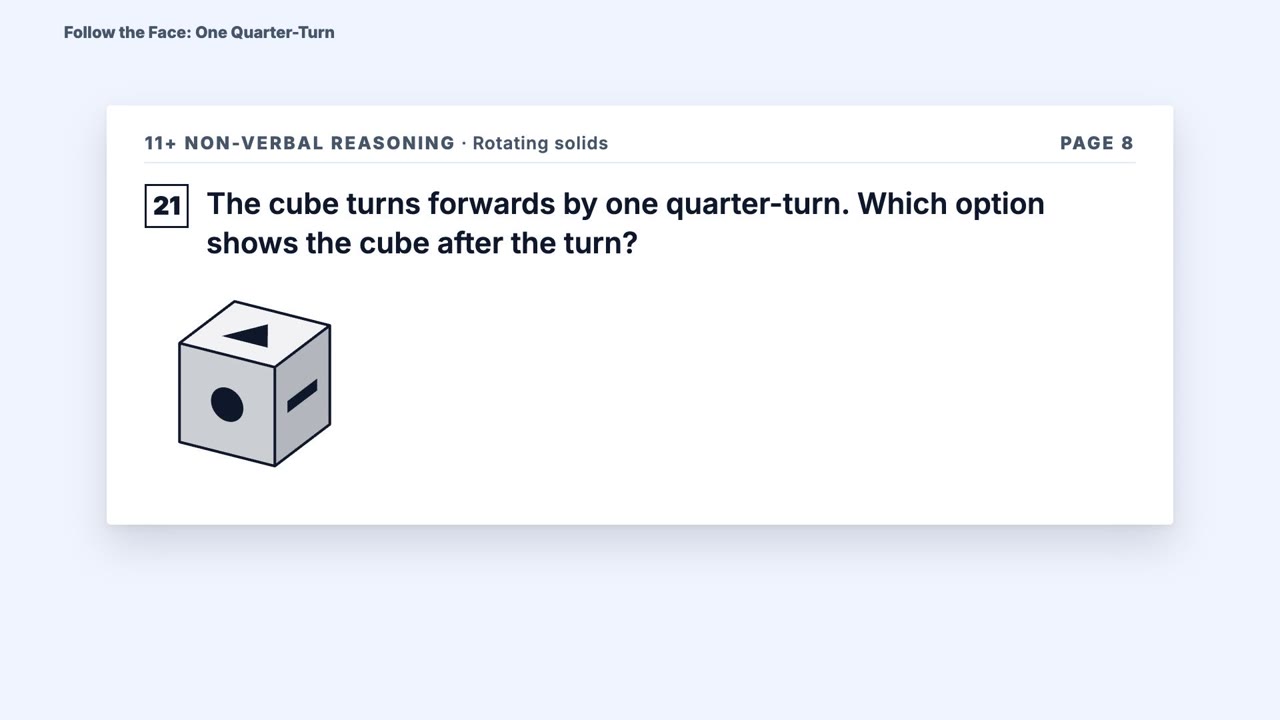
 Length 2:30
Follow the Face: One Quarter-Turn
Rotate a 3D solid mentally
11+ Non-verbal Reasoning · Spatial
A short worked example (2:34) for one 11+ non-verbal reasoning skill: Match a solid and its view.
This video shows how to match a three-dimensional arrangement to its view from a specified position. Watch an 11+ non-verbal reasoning question solved step by step.
Turn on captions with the CC button. The full transcript is below the video.
Every word of the video, to read along or to skim before watching.
A jumble of cubes can change completely when you move around it. But lock one view... and a complicated solid becomes a simple pattern. The trick is not counting every cube. You only record the tallest stack that blocks each straight line of sight.
First, lock the requested camera: front, side, or plan. Keep that direction fixed. The solid turns square to you, so the final view has no slant and no perspective. Now trace one viewing lane at a time. Cubes behind one another overlap. Keep the tallest visible stack in that lane, then sweep steadily to the next lane. A raised cube cannot float. If you see one above the floor, faint hidden support cubes must sit underneath it, even when the front cube hides them. Do not count only what is obvious.
Let's work through an example. A joined-cube solid stands on a square base. An arrow labelled FRONT fixes the viewing direction. From left to right, its four lanes will project to heights two, three, one, and two. Choose the matching grid. Option A shows two, three, one, two. Option B shows two, two, two, two. Option C shows two, three, two. Option D shows two, three, a gap, two. Which option is correct? Lock FRONT. The solid rotates square to you. Sweep left to right. The first lane reaches two cubes; the second, three; the third, one; the fourth, two. Squash the depth... and the projection settles as two, three, one, two. Compare in order. Option C is only three lanes wide, so its width fails. Option B has four lanes, but the second and third heights fail. Option D has the right width and heights around the edge, but its gap fails. Our third lane contains one cube. That raised top cube cannot float. A faint hidden support underneath still counts, even when another cube hides it. So the correct answer is Option A.
Lock the view, sweep each lane, keep its tallest stack, then compare width, height, and gaps. You can match any solid with confidence!
Watch these next. The first ones teach the skills closest to this one.
Length 2:30Rotate a 3D solid mentally
 Length 2:29
Track a paper fold
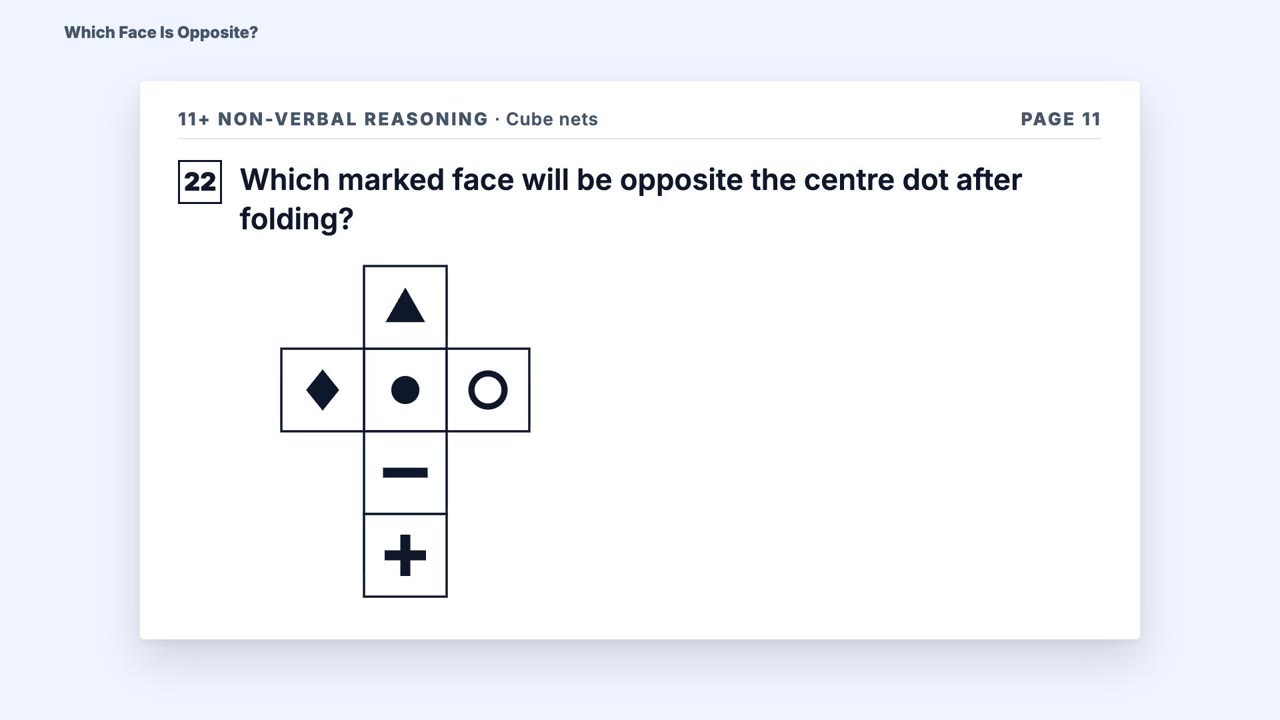 Length 2:28
Track opposite cube faces
The free diagnostic checks maths, English and both kinds of reasoning, and shows what to practise next. No card is required.