
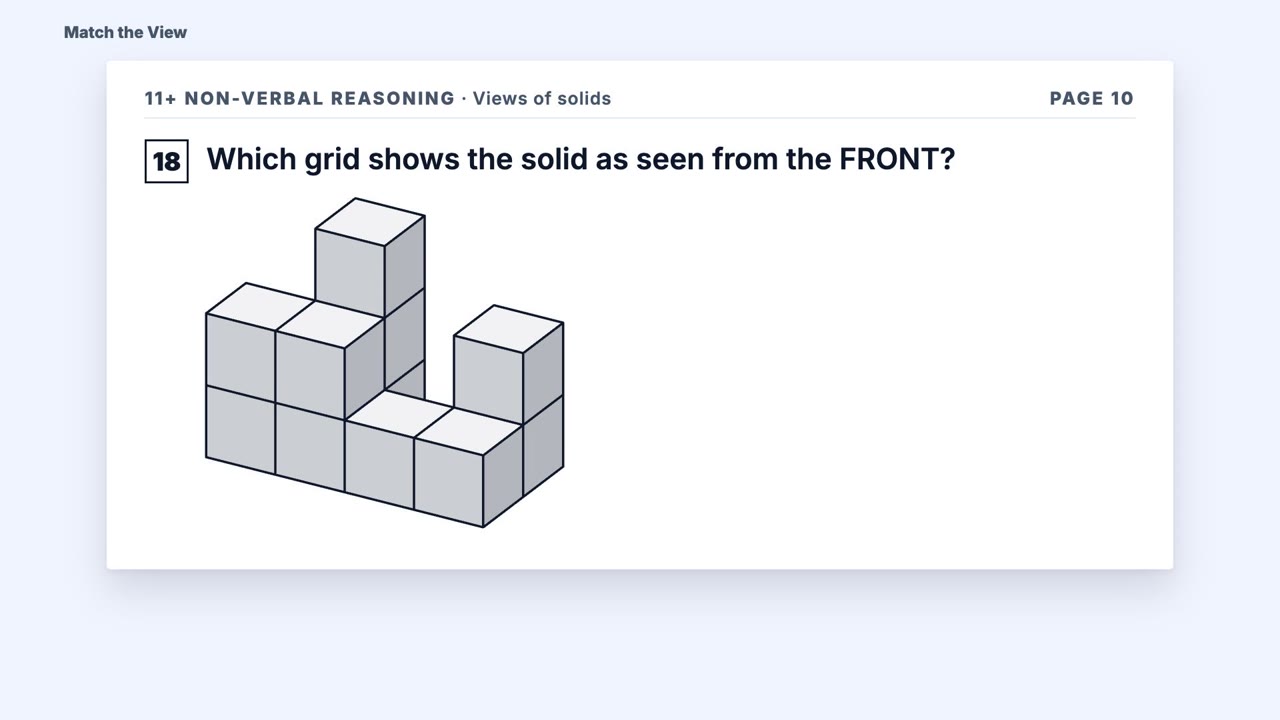
 Length 2:34
Match the View
Match a solid and its view
11+ Non-verbal Reasoning · Spatial
A short worked example (2:37) for one 11+ non-verbal reasoning skill: Find an embedded shape.
This video shows how to find a target shape within a more complicated figure despite distracting lines. Watch an 11+ non-verbal reasoning question solved step by step.
Turn on captions with the CC button. The full transcript is below the video.
Every word of the video, to read along or to skim before watching.
A shape can hide in a forest of lines. Watch the spotlight sweep across the clutter... there! The target's route flashes, then the clutter closes in. Could you find it again?
Start with its fingerprint. Count the sides. Compare the long and short edges. Now follow the target one edge at a time, turning at every join. The lens leads just ahead, and each matching edge settles onto the flat search figure without changing length or angle. When the complete route glows, lift a copy out of the clutter. Rotate it beside the target. It matches: same sides, same lengths, same sequence of turns. Rotation is allowed. Keep shapes flat and undistorted. But do not flip it like a mirror, and do not stretch an edge to make it fit. A reflected or deformed shape is NOT the target.
Let's work through an example. Here is the target: a four-sided shape with one long base, two slanting sides, and a short top edge. Four equal cards contain dense line figures. Option A has a narrow tilted route. Option B has a broad route near the centre. Option C has a similar route low down. Option D has a mirrored route on the right. Which option is correct? Search systematically. In A, count four sides, but the upper join turns too sharply. Reject it. In C, the base is too short, even though the outline looks tempting. Reject it. D has the right lengths, but its turn sequence is reflected. Rotating cannot repair a mirror image. Now scan B from the long base. Trace the first slant, then the short top, then the second slant, and close the base. Each edge lands exactly. Every join agrees. The distractor lines recede, and the completed route lifts into the comparison space. Rotate it beside the target... perfect match. The answer is Option B.
Remember the fingerprint: count the sides, compare the lengths, and follow every turn. Allow rotation, never reflection or stretching. Keep your eyes on the route, and you will spot hidden shapes with confidence!
Watch these next. The first ones teach the skills closest to this one.
Length 2:34Match a solid and its view
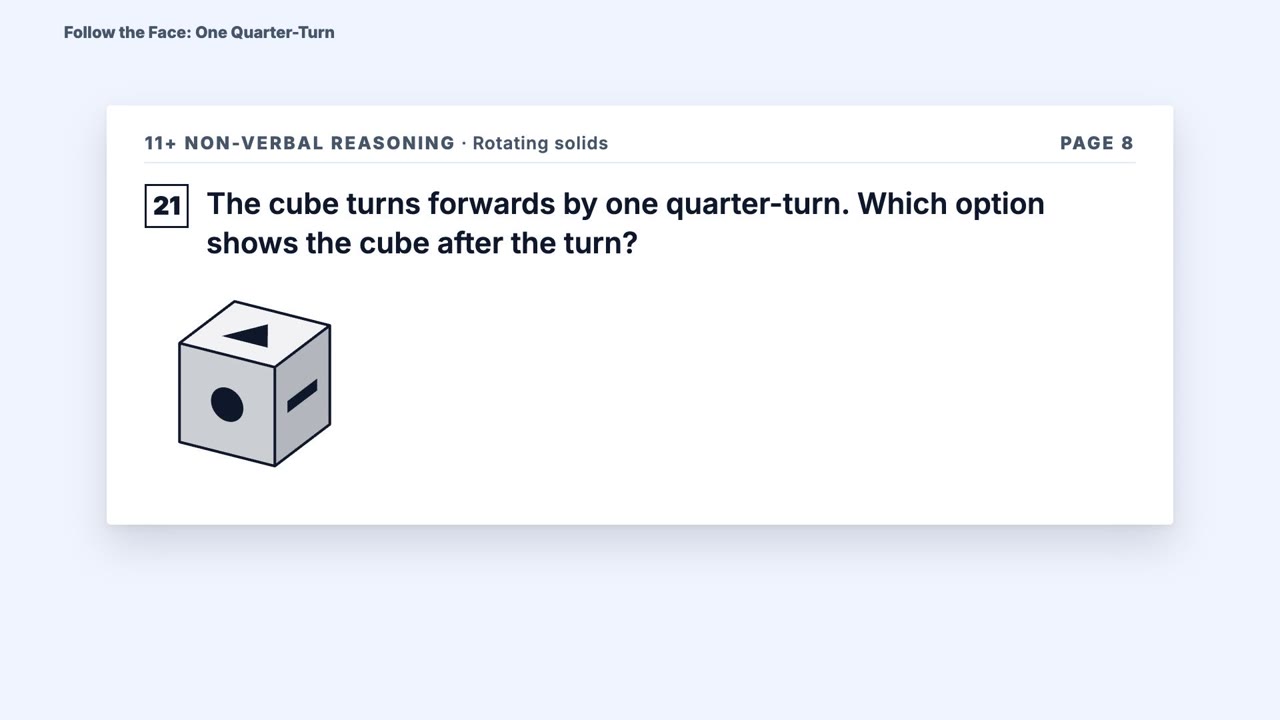 Length 2:30
Rotate a 3D solid mentally
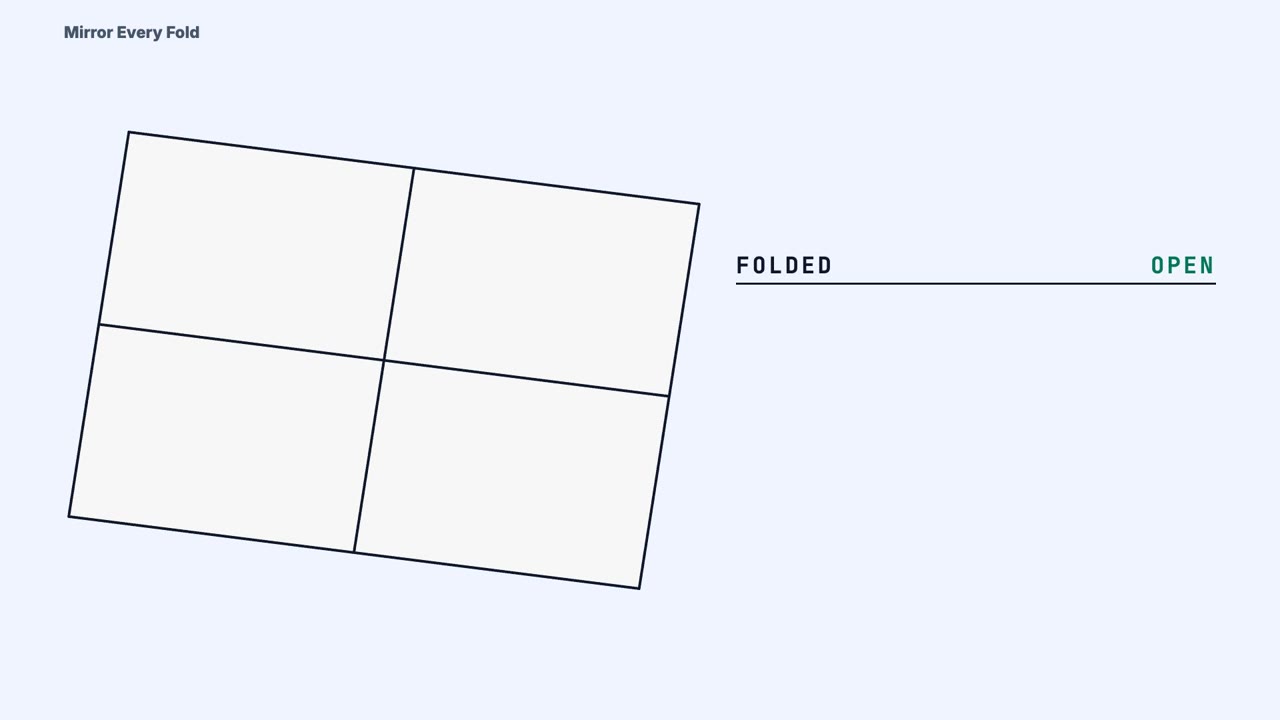 Length 2:29
Track a paper fold
The free diagnostic checks maths, English and both kinds of reasoning, and shows what to practise next. No card is required.