
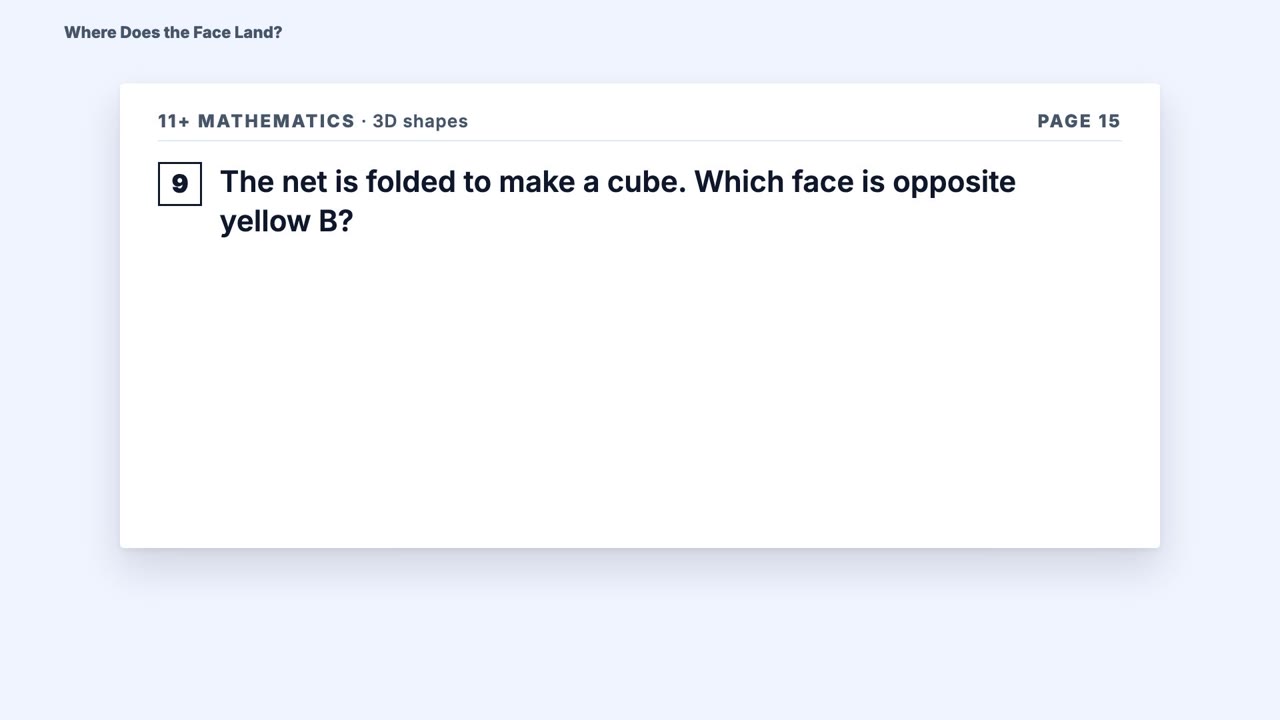
 Length 2:26
Where Does the Face Land?
Track cube faces from a net
11+ Maths · Geometry
A short worked example (2:41) for one 11+ maths skill: Solve an angle relation.
This video shows how to use angle rules for lines, points, triangles or quadrilaterals to calculate a missing angle. Watch an 11+ maths question solved step by step.
Turn on captions with the CC button. The full transcript is below the video.
Every word of the video, to read along or to skim before watching.
One tiny angle can hide in a crowded shape... yet a single fact can uncover it. The trick is not guessing what the picture looks like. It is spotting the relationship that MUST stay true.
First, read the diagram like a detective. Look for a straight line, angles around a point, a triangle, or a quadrilateral. Each clue gives a fixed total: angles on a straight line total one hundred and eighty degrees; angles around a point total three hundred and sixty degrees; a triangle totals one hundred and eighty degrees; and a quadrilateral totals three hundred and sixty degrees. Now cover the unknown with a question mark. Add the angles you know. Then subtract that known total from the shape's fixed total. Your answer fills the gap, because all the angles together must still make the whole. A diagram may be turned sideways, but its angle relationship has not changed. Turn the shape in your mind while keeping every corner in the same order. Do not mirror it. A flipped picture can make you match the unknown to the wrong corner.
Let's work through an example. A quadrilateral has interior angles of eighty-two degrees, ninety-seven degrees, one hundred and eleven degrees, and angle x. What is the size of angle x? The diagram shows four corners in order, with x at the final corner. The quadrilateral relationship is the clue: all four interior angles total three hundred and sixty degrees. First, add the three known angles. Eighty-two plus ninety-seven is one hundred and seventy-nine. Add one hundred and eleven... that makes two hundred and ninety degrees. Now compare the known total with the whole. Three hundred and sixty minus two hundred and ninety equals seventy. So angle x is seventy degrees. Watch the question mark turn into seventy degrees, and check: two hundred and ninety plus seventy returns to three hundred and sixty. The relationship balances exactly.
Spot the relationship, total the known angles, then subtract to reveal the missing one. Keep the corners in order, trust your check, and you can solve it!
Watch these next. The first ones teach the skills closest to this one.
Length 2:26Track cube faces from a net
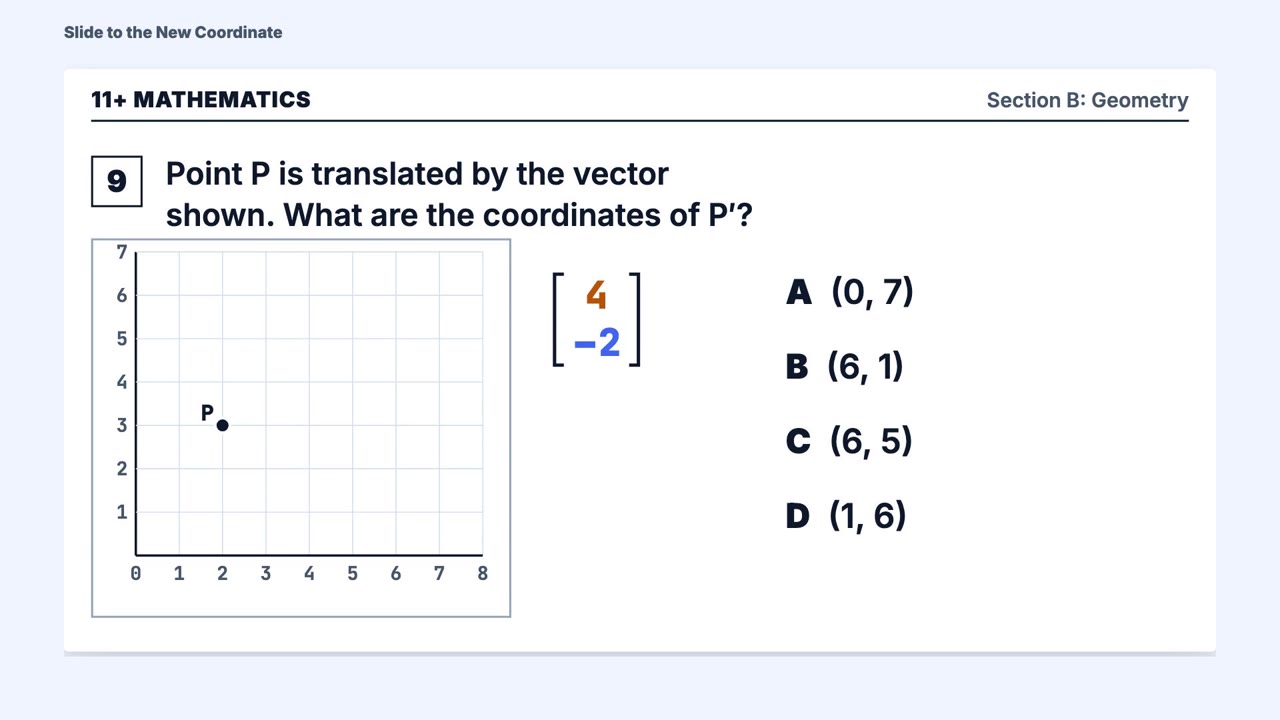 Length 2:37
Translate a coordinate
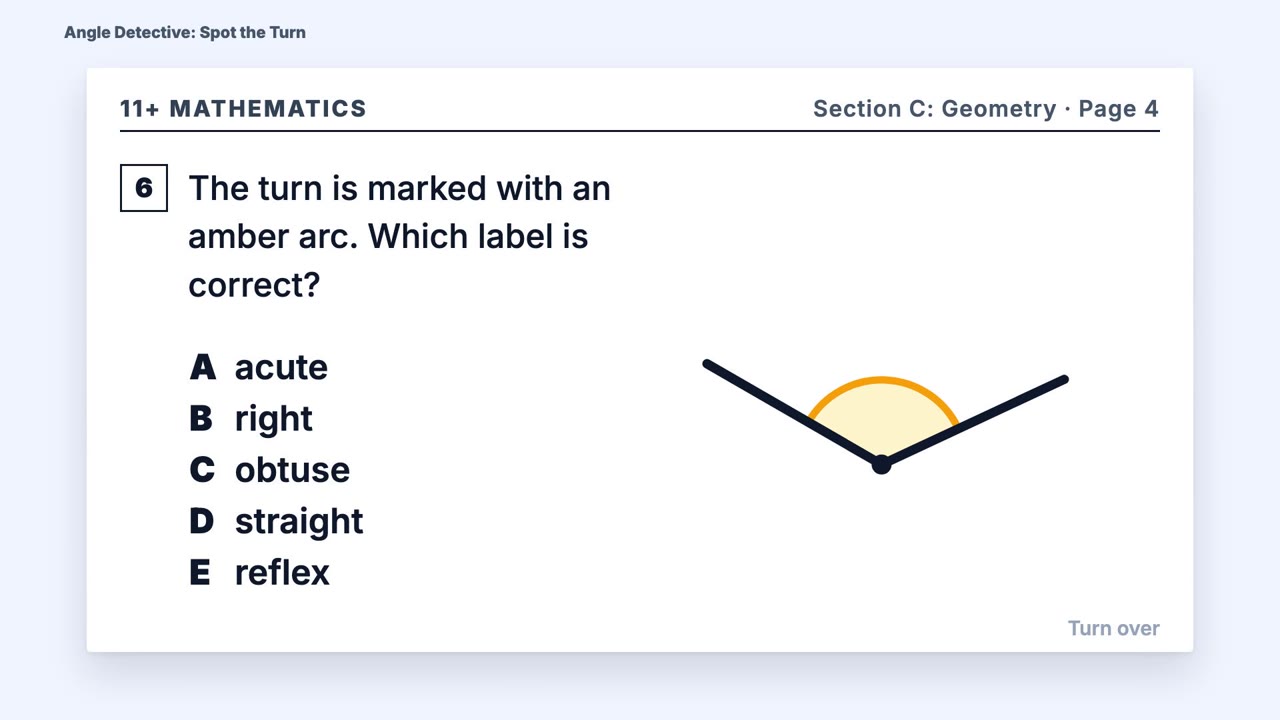 Length 2:37
Classify an angle
The free diagnostic checks maths, English and both kinds of reasoning, and shows what to practise next. No card is required.