
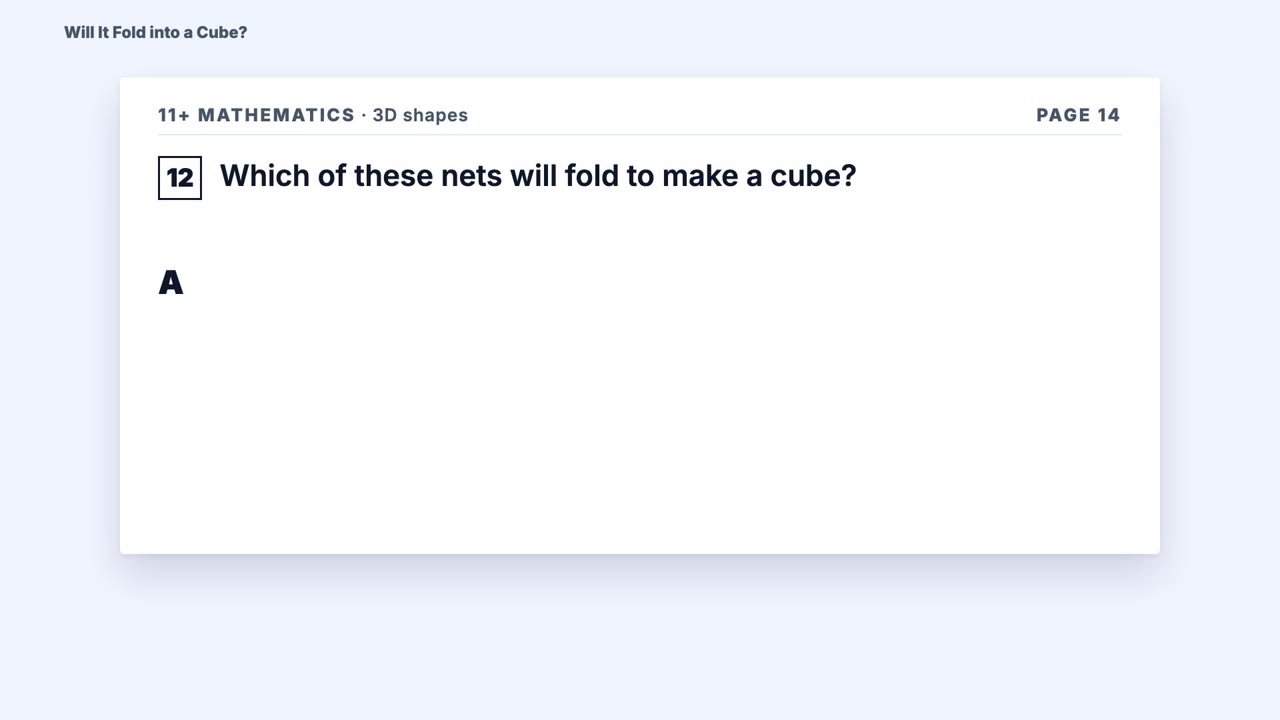
 Length 2:24
Will It Fold into a Cube?
Identify a cube net
11+ Maths · Geometry
A short worked example (2:37) for one 11+ maths skill: Compose coordinate transformations.
This video shows how to apply two transformations to a point on a coordinate grid in the correct order. Watch an 11+ maths question solved step by step.
Turn on captions with the CC button. The full transcript is below the video.
Every word of the video, to read along or to skim before watching.
A shape can finish in a completely different place after just two moves. But here is the twist... swapping those moves can change the final answer. So how do you keep control? Treat transformations like instructions in a queue: first one, then the next.
Start with the original shape on a coordinate grid. Read every point across first for x, then up or down for y. Horizontal BEFORE vertical. If you reverse that order, you plot a different point before the transformations even begin. Now read the two instructions from top to bottom. Complete the first transformation for ALL the vertices, and label the new image. Only then use that image as the starting shape for instruction two. The first answer becomes your new input. A translation slides every point by the same amount. A rotation turns every point around its stated centre. Watch the corner order and the shape's orientation: a turn does not make a mirror image. It stays the same shape, simply facing another way.
Let's work through an example. Triangle A B C has vertices A at one, one; B at three, one; and C at one, two. First, translate it four squares right and one square up. Then rotate the image ninety degrees clockwise about the origin. Find the final coordinates. Do instruction one. Add four to each x-coordinate and one to each y-coordinate. A moves to five, two. B moves to seven, two. C moves to five, three. Pause there... these three points form the translated image, ready for the rotation. For a ninety-degree clockwise turn about the origin, each point at x, y moves to y, negative x. Apply that to the translated image, not the original. A finishes at two, negative five. B finishes at two, negative seven. C finishes at three, negative five. Those are the final coordinates.
Remember: read x before y, follow the instructions in order, and make each new image your next starting shape. Two transformations, one careful chain... you've got it!
Watch these next. The first ones teach the skills closest to this one.
Length 2:24Identify a cube net
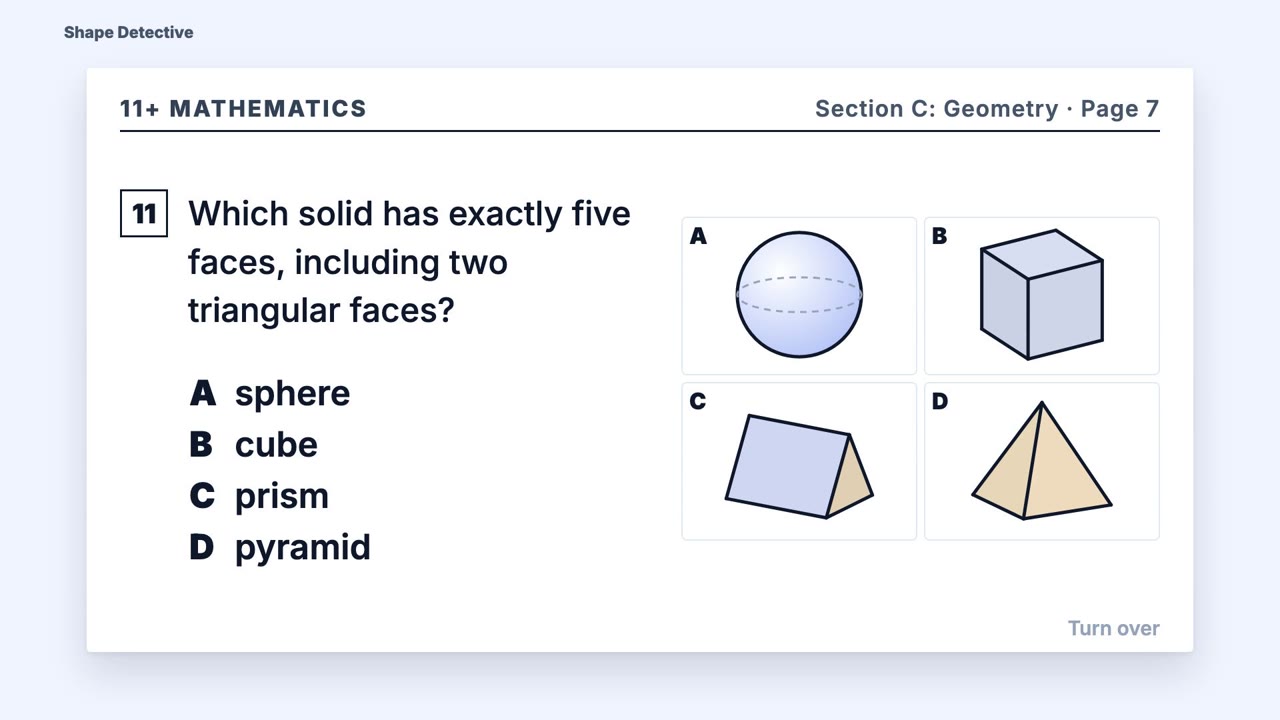 Length 2:38
Identify a shape property
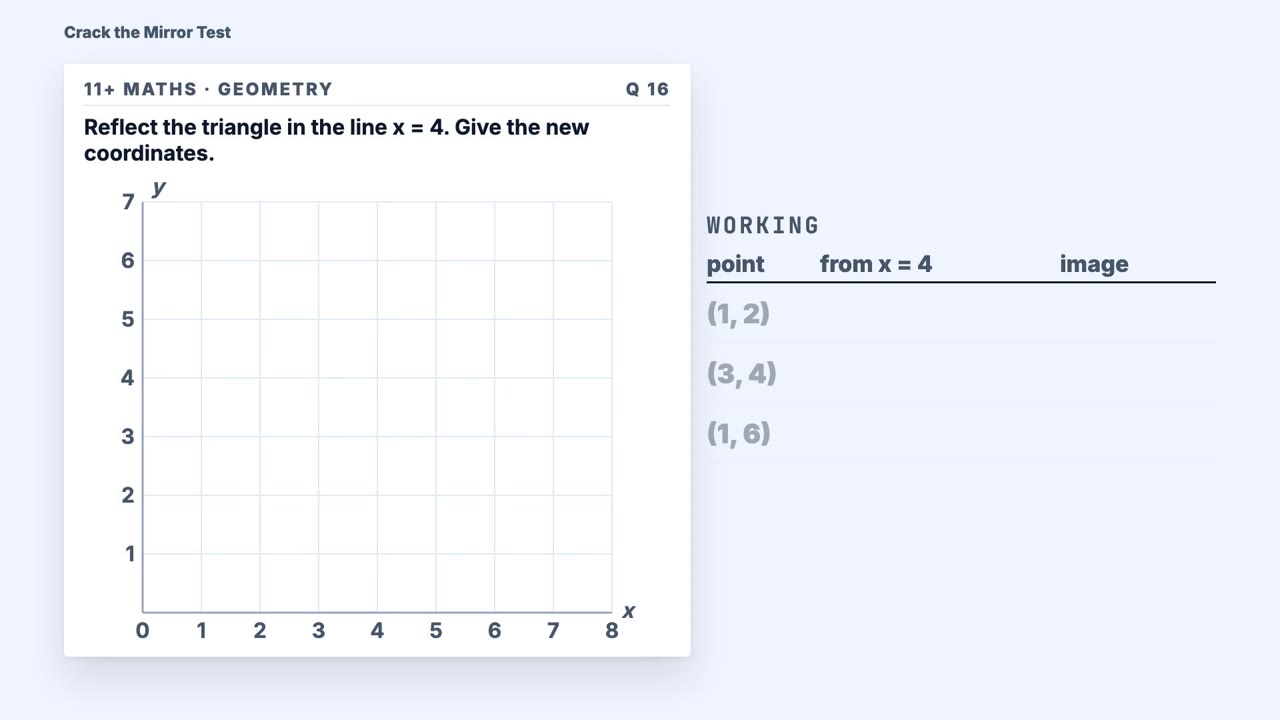 Length 2:29
Identify line symmetry
The free diagnostic checks maths, English and both kinds of reasoning, and shows what to practise next. No card is required.