
 Length 2:28
Find the True Opposite
Select an antonym
11+ English · Vocabulary
A short worked example (2:37) for one 11+ English skill: Resolve a homophone.
This video shows how to choose the correctly spelt word when two words sound the same but have different meanings. Watch an 11+ English question solved step by step.
Turn on captions with the CC button. The full transcript is below the video.
Every word of the video, to read along or to skim before watching.
Two words can sound exactly the same, yet only one can unlock a sentence. Your ears hear a tie... so how can your eyes choose the winner? The trick is simpler than it seems.
These sound-twins are called homophones. They have the same sound, but different spellings and meanings. Picture each spelling as a key. The sentence gives you clues, and only the key with the right meaning will fit. You solve the puzzle with meaning, not volume. Take "see" and "sea". "See", spelled S-E-E, is the verb meaning to notice something with your eyes. "Sea", spelled S-E-A, is a large area of salt water. The letters look different because the meanings are different. One belongs to looking; the other names water. Here is the trap: choosing the spelling that feels familiar, or choosing by sound alone. Both words sound like "see", so sound cannot decide. Replace the gap with each meaning. Then read the whole sentence and ask, "Does that meaning make sense?"
Let's work through an example. Choose the correct word to complete this sentence: "From the hilltop, the hikers could blank the lake below." The options are "see", spelled S-E-E, and "sea", spelled S-E-A. First, inspect the clue "the lake below". A lake is something the hikers can notice with their eyes. That points to the action meaning: "see". The word after "could" should tell what they were able to do. Now test it in the gap. "From the hilltop, the hikers could see the lake below." Every part makes sense. Now test "sea". It means salt water, so we would get: "the hikers could salt water the lake below." That cannot work after "could", because the sentence needs an action. The sound matches, but the meaning fails. The explicit answer is "see", spelled S-E-E.
When homophones sound identical, do not guess from your ears. Use the sentence clue, swap in each meaning, and choose the spelling that makes complete sense. Meaning breaks the tie - and now you can too!
Watch these next. The first ones teach the skills closest to this one.
Length 2:28Select an antonym
 Length 2:38
Select a synonym
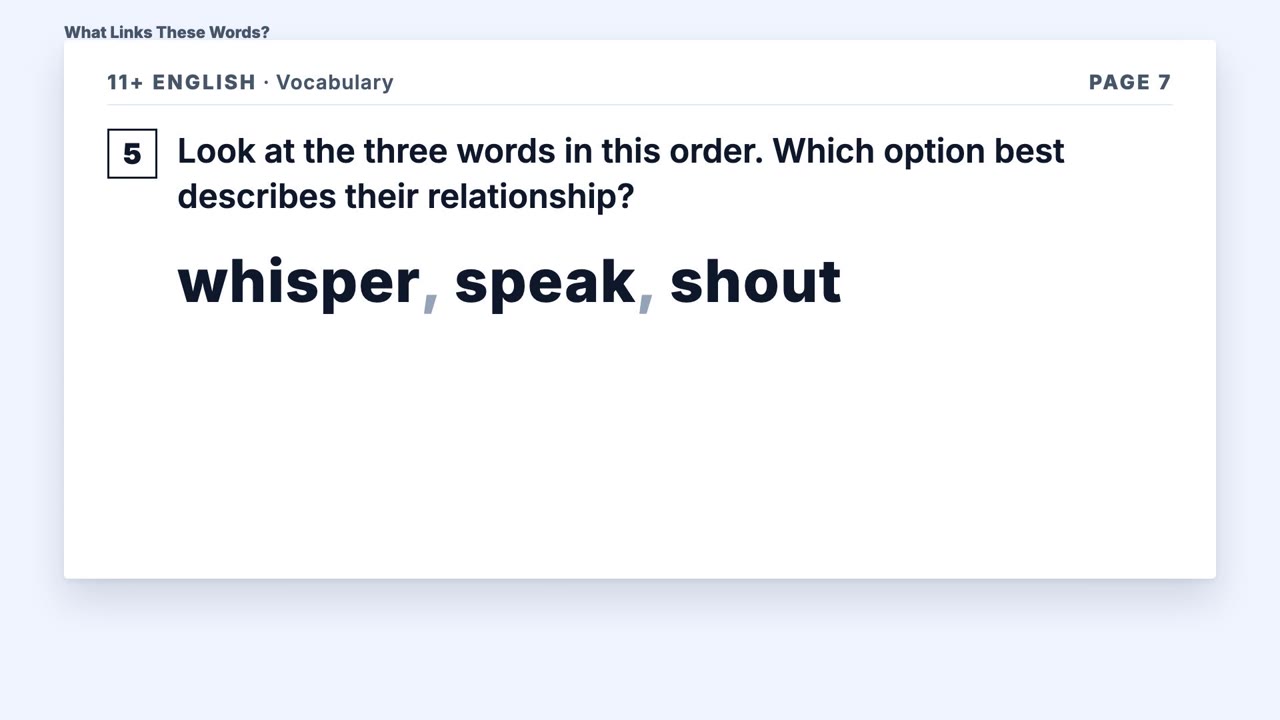 Length 2:40
Classify a word relationship
The free diagnostic checks maths, English and both kinds of reasoning, and shows what to practise next. No card is required.