
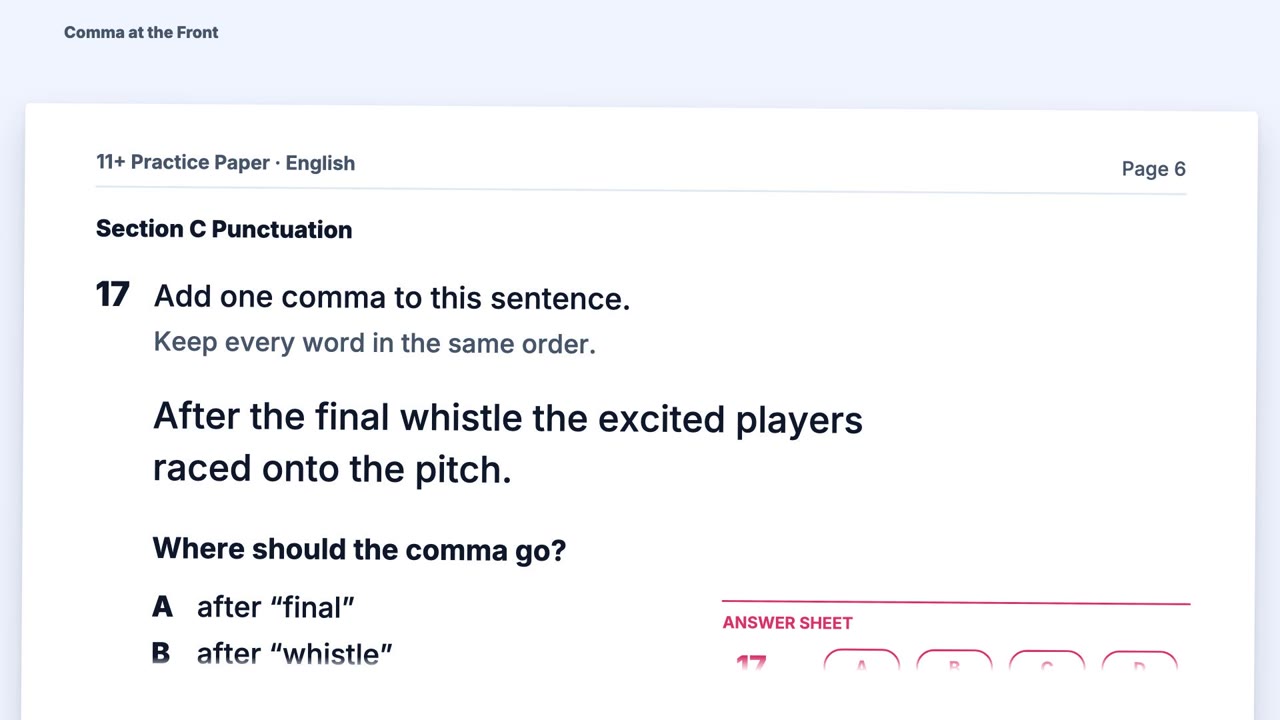
 Length 2:45
Comma at the Front
Punctuate a fronted adverbial
11+ English · Punctuation
A short worked example (2:49) for one 11+ English skill: Punctuate direct speech.
This video shows how to place speech marks and other punctuation correctly around spoken words. Watch an 11+ English question solved step by step.
Turn on captions with the CC button. The full transcript is below the video.
Every word of the video, to read along or to skim before watching.
A sentence can contain exactly the right words and still hide who is speaking. Add just a few tiny marks, and the voice suddenly becomes clear. Ready? Watch these words turn into speech...
Direct speech gives the speaker's exact words. Put opening speech marks immediately before the first spoken word, and closing speech marks immediately after the final spoken punctuation. They work like a pair of gates. Everything actually said stays between them. The speaker's name and the reporting verb stay outside. If the spoken words come first, place a comma before the closing speech marks when the reporting clause follows. For example: "The gate is locked," said Mina. The comma belongs inside the speech marks. Then use a lower-case letter for said, because the whole construction is one sentence. Do not confuse a speech mark with an apostrophe. An apostrophe can show missing letters in a contraction, as in "can't". It sits inside one word. Speech marks surround the complete spoken words. Different marks. Different jobs.
Let's work through an example. Here is the question: add the missing punctuation around the direct speech in this sentence, without changing any words. Lucy whispered I found the key. You need to punctuate one complete direct-speech construction. First, find the exact words Lucy says: I found the key. Place the opening speech marks directly before the capital I. Place the closing speech marks after the full stop. The complete spoken sentence now sits safely inside the pair. Now check the reporting clause. Lucy whispered comes before the speech, so put a comma after whispered. Leave one space, then open the speech marks. The comma separates the reporting clause from Lucy's exact words. Read the finished answer: Lucy whispered, "I found the key." The capital I and the full stop stay exactly as written. We added only the comma and the paired speech marks. Nothing inside Lucy's message changed.
Remember: separate the reporting clause, then wrap the exact spoken words in paired speech marks, with their ending punctuation inside. You can make every speaker crystal clear!
Watch these next. The first ones teach the skills closest to this one.
Length 2:45Punctuate a fronted adverbial
 Length 2:35
Punctuate a list
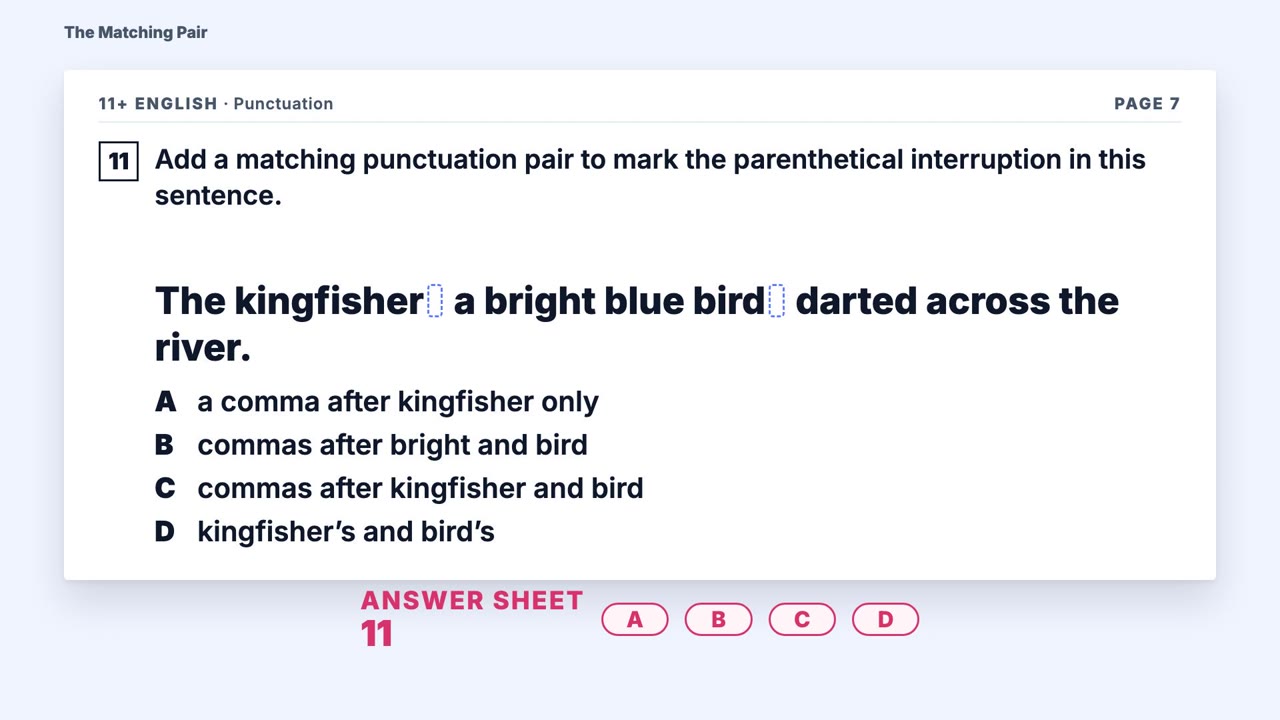 Length 2:48
Punctuate parenthesis
The free diagnostic checks maths, English and both kinds of reasoning, and shows what to practise next. No card is required.