
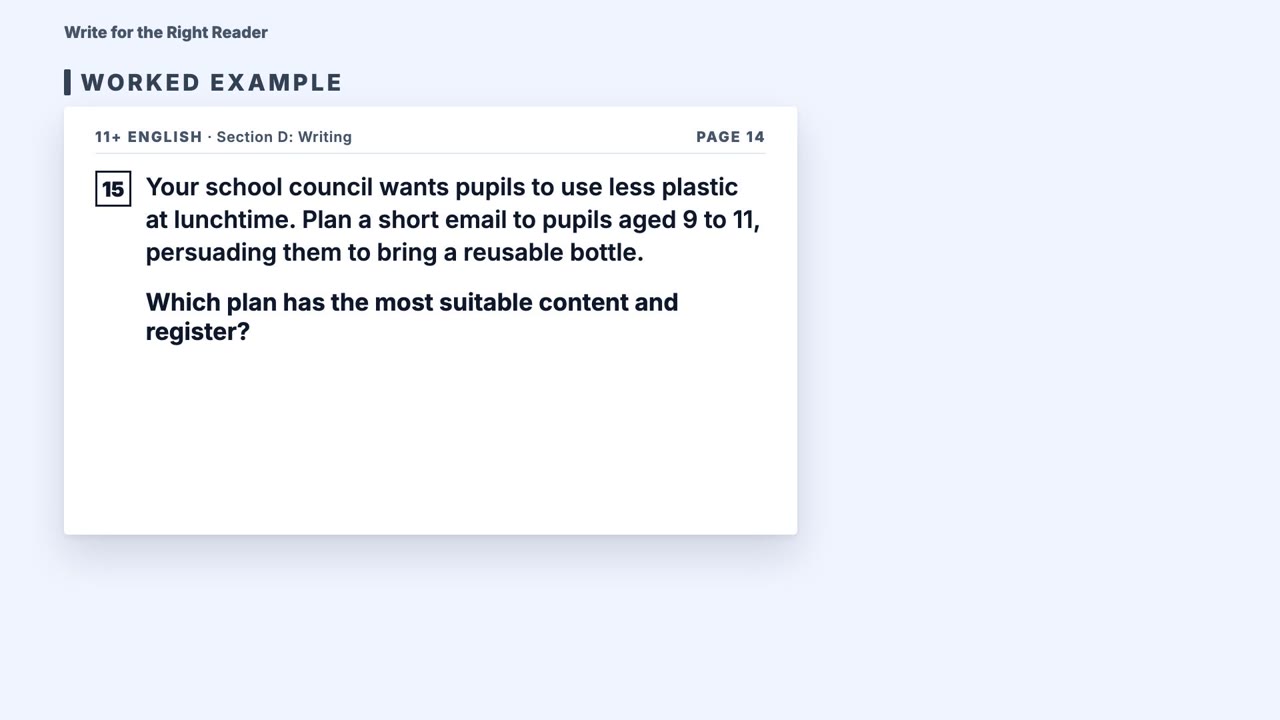
 Length 2:43
Write for the Right Reader
Plan for purpose and audience
11+ English · Writing
A short worked example (2:44) for one 11+ English skill: Organise an argument.
This video shows how to put reasons and supporting evidence in a clear order to argue for a point of view. Watch an 11+ English question solved step by step.
Turn on captions with the CC button. The full transcript is below the video.
Every word of the video, to read along or to skim before watching.
Six sensible sentences can still make a muddled argument. The secret is ORDER... putting each idea where your reader needs it.
Start with the position: the view the writer wants the reader to accept. Place it first, like a signpost. Every later sentence should support that same view, not wander to a different topic. Next, group each reason with matching evidence. A reason explains WHY the position makes sense. Evidence is an example, detail or fact supplied to support it. Keep the pair together, so the reader never hunts for the connection. Then choose a deliberate order. Move from a familiar reason to a powerful one, and finish by restating the position. Do not arrange cards by repeated words. Repetition can trick you; meaning decides which evidence belongs where.
Let's work through an example. Six cards argue for this position: Our school should create a quiet reading area. A says, 'A quiet space would help pupils concentrate on books.' B says, 'For instance, soft screens could reduce nearby chatter.' C says, 'The school should therefore create the area.' D says, 'It would also make reading available at break time.' E says, 'For example, pupils could use it during indoor break.' F says, 'Our school should create a quiet reading area.' Put the cards in the clearest order. Begin with F. It states the position. Next comes A, the first reason: concentration. B follows, because 'For instance' introduces evidence about reducing chatter. Now place D, the second reason: reading at break time. E supports it with the indoor-break example. Finish with C. The word 'therefore' signals a conclusion, so it belongs after both reason-and-evidence pairs. The complete order is F, A, B, D, E, C. Notice: we organised the supplied ideas. We did not test whether they were factually true.
Remember the route: position, reason, matching evidence; then another reason, matching evidence, and conclusion. Keep every pair together, follow the meaning, and your argument will lead the reader confidently from start to finish.
Watch these next. The first ones teach the skills closest to this one.
Length 2:43Plan for purpose and audience
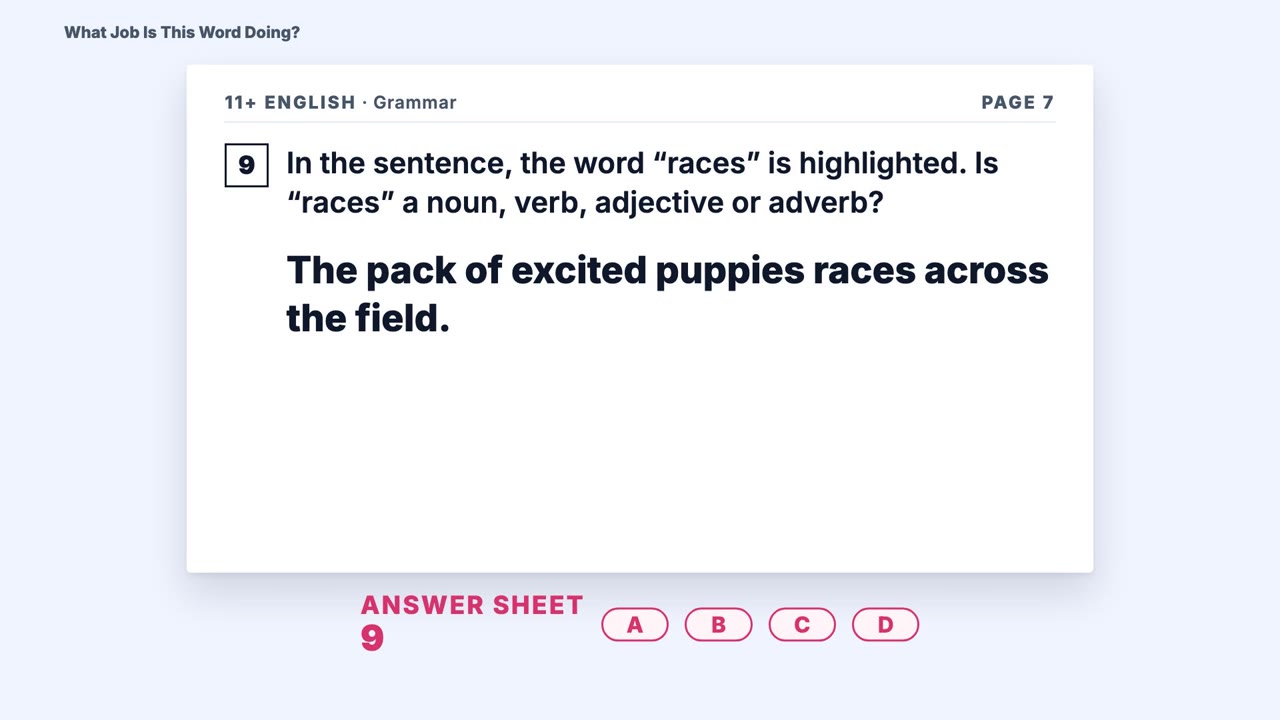 Length 2:35
Classify a word in context
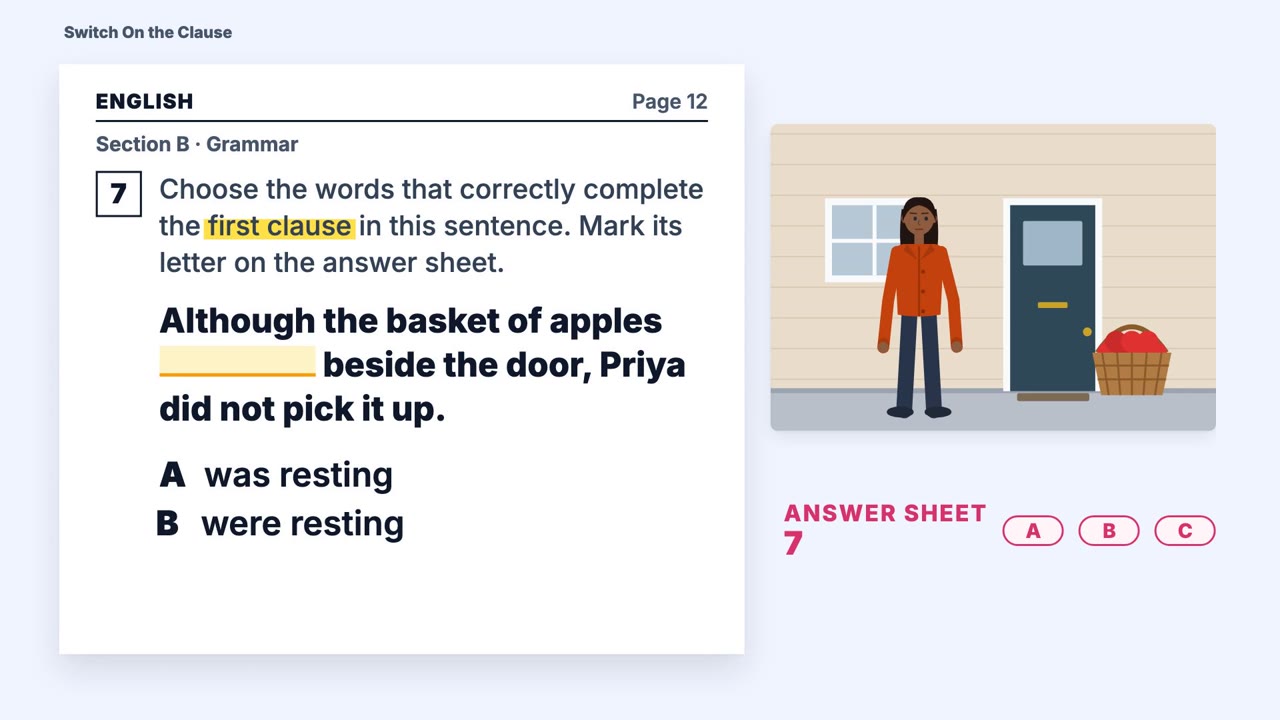 Length 2:38
Complete a finite clause
The free diagnostic checks maths, English and both kinds of reasoning, and shows what to practise next. No card is required.