
Is the 11 Plus Hard? Difficulty, Competition and Managing Pressure
Most pages answer this with an unsourced "top 10 to 25%". Buckinghamshire Council expects about 37% of its test-takers to qualify. Here is what the admission authorities actually publish about difficulty, competition and pressure.
 Elspeth Marlow
- 15 min read
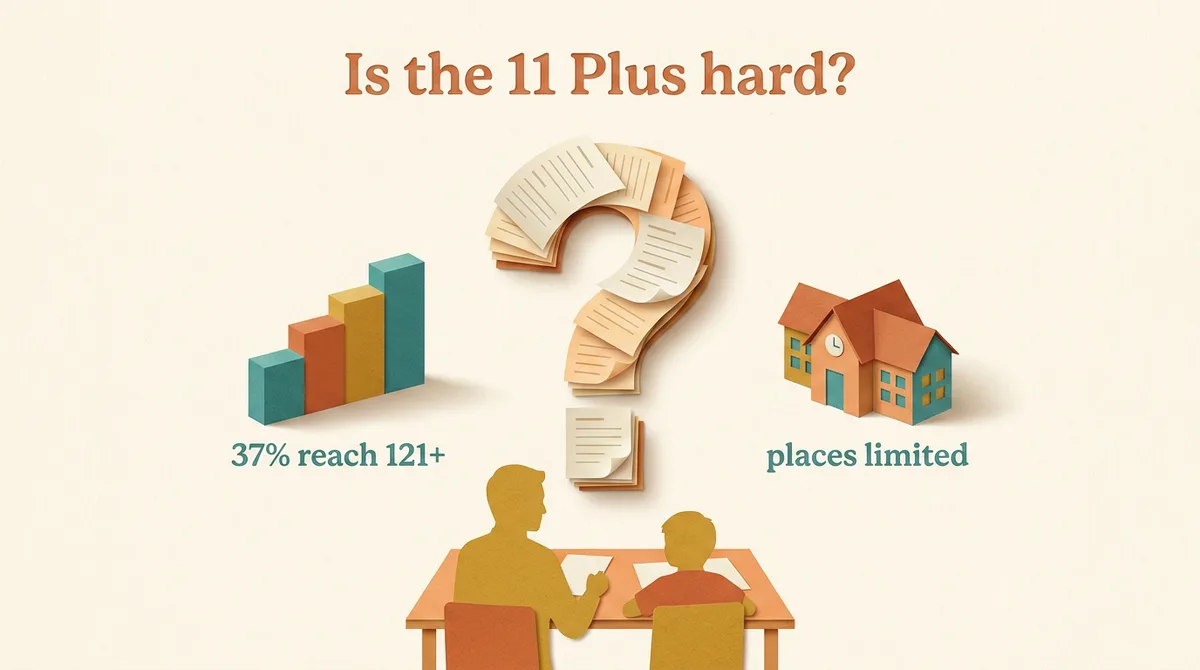
Ask the internet whether the 11 plus is hard and you get a remarkably consistent answer: yes, it is challenging, and it selects roughly the top 10% to 25% of children. That sentence appears on tutoring explainers, in forum replies and, increasingly, in the AI summary that sits above the search results. What almost none of those sources do is name the body that published the figure, because in most cases no such body did.
So here is a number that comes straight from an admission authority. Buckinghamshire Council, which runs one of the largest fully selective systems in England, states plainly of its Secondary Transfer Test: "We expect that about 37% of children will get an STTS of 121 or more." That is double to triple the figure the consensus repeats. It does not mean the test is easy. It means the popular framing of 11 plus difficulty is not describing the thing parents think it is describing.
This guide answers the literal question using figures published by the people who set the thresholds: Buckinghamshire Council and The Buckinghamshire Grammar Schools, Sutton Grammar School and the Sutton consortium, Tiffin School, the CSSE in Essex, a Kent grammar school, and the Department for Education. It then does the thing the ranking pages leave out entirely: it uses those numbers to work out how much preparation is actually justified, and when to stop, which is the question our guide to preparing for the 11 plus year by year builds a full timeline around.
Is the 11 plus hard? The short answer
The test is hard in a specific and limited sense. The papers sit above the pace and level of typical Year 6 classwork, they are tightly timed, and in most areas they include reasoning question types that are not taught in the primary curriculum at all. A capable child who has never seen the format will usually underperform their ability on a first attempt.
The test is not hard in the sense of being a narrow filter everywhere. In Buckinghamshire, roughly three or four children in ten are expected to clear the qualifying standardised score of 121. In a super-selective school such as Tiffin, the effective bar is far higher, because the school takes only the strongest performers rather than everyone above a fixed line.
That gap between the two systems is the whole story. Answering "is the 11 plus hard?" without saying which system you are in produces advice that is either needlessly frightening or dangerously relaxed.
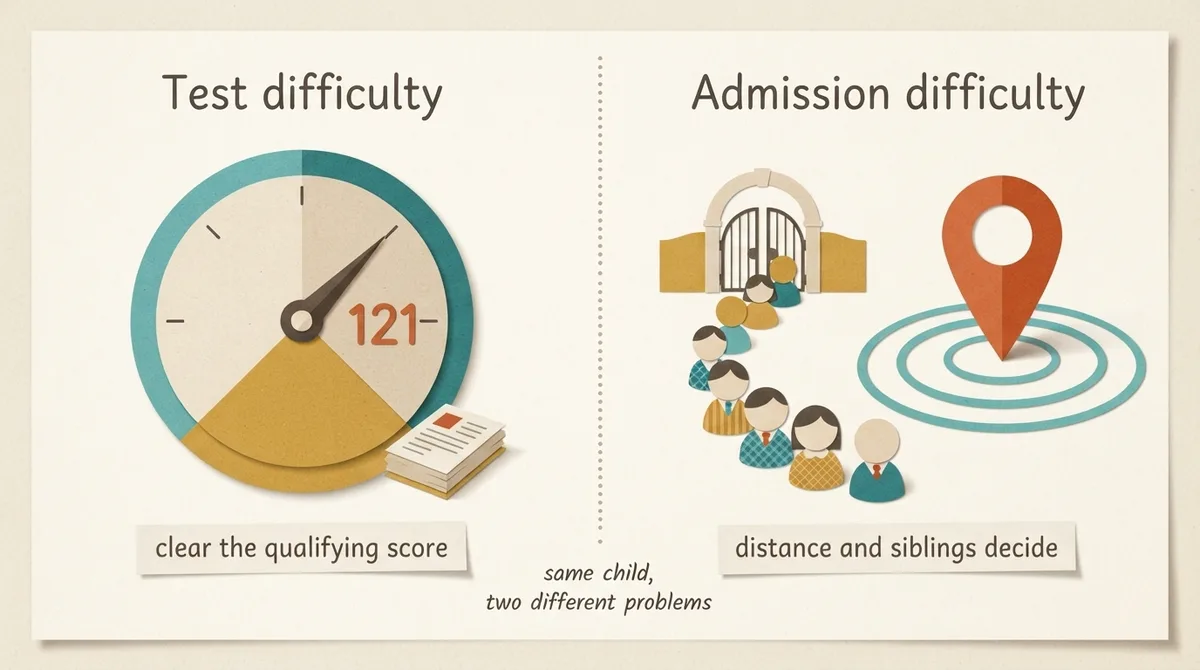
What are the two different difficulties parents keep confusing?
There are two separate problems and they behave in opposite ways.
Test difficulty is clearing the qualifying score. It is a measurable target, it responds to practice, and in a threshold area it has a published number attached to it.
Admission difficulty is getting a place once you have cleared it. It responds to where you live, whether you have a sibling at the school, and how many other qualified children applied. It does not respond to revision at all.
Buckinghamshire demonstrates the split better than any other system, because the council writes it down. It confirms that "a score above 121 does not mean your child has a higher priority for a grammar school place as Buckinghamshire grammar schools do not use score as an admission rule", and separately that "every year there are far more qualified children than grammar school places", with sibling status and catchment residency deciding between qualified applicants (Buckinghamshire Council).
Read those two statements together and something uncomfortable follows. In that system, every hour of preparation beyond the point where a child reliably clears 121 buys nothing. Not a tie-break, not a nudge, not an edge. The scarce resource is proximity, and no amount of practice moves your house.
In a super-selective system the logic inverts. There is no fixed line to clear and then rest on, because ranking continues all the way up. Extra marks keep counting, which is precisely why the pressure in those catchments is harder to contain.
What are the qualifying scores, according to the people who set them?
Buckinghamshire publishes the clearest set of figures. GL Assessment marks the papers and standardises each child's marks for age in years and months, producing scores between 60 and 170. The Secondary Transfer Test Score is weighted 50% verbal, 25% mathematical and 25% non-verbal, and the qualifying score is 121. The Buckinghamshire Grammar Schools confirm the same threshold.
Kent works differently again. Tunbridge Wells Girls' Grammar School states: "We do not have cut off grades. We accept applications from any pupil who is 'grammar-assessed' by KCC, i.e. who has passed the test with the required scores in each paper and met the aggregate score. The score threshold changes each year." The school's Published Admission Number is 174 Year 7 places. A moving threshold means last year's number is a guide, never a target.
The Sutton consortium goes furthest in refusing to give parents a figure in advance. Sutton Grammar School states: "It is not possible to state a pass mark in advance of the test. The pass mark will be decided by the participating schools after the test has been marked" (Sutton Grammar School admissions FAQs). Children who pass are not even told their scores; only those who do not pass receive them.
That single fact dismantles the most common preparation goal parents set. If the pass mark is decided after marking, no tutor, app or practice paper can tell you in advance what score you needed. You can only aim to perform as well as the child reasonably can, then stop. Our guide to 11 plus pass marks and qualifying scores by area goes region by region, and the mechanics of age weighting are covered in how standardised scores work.
How far above school level do the papers actually sit?
Difficulty comes as much from format and clock as from content. The Buckinghamshire Secondary Transfer Test is two papers of about 60 minutes each with a break between, one assessing verbal skills and the other mathematical and non-verbal skills, with a shorter practice test usually taken two days before the main test.
The CSSE test in Essex looks nothing like it. It is an English paper lasting sixty minutes with ten minutes of additional reading time, plus a Mathematics paper lasting sixty minutes, with no separate verbal or non-verbal reasoning paper at all. A child prepared exclusively on reasoning drills would be badly aimed for Essex, and a child prepared only on English and maths would be badly aimed for Buckinghamshire.
This is why the generic answer fails. The honest version is: the 11 plus asks curriculum knowledge to be applied at unusual speed, under unfamiliar formats that vary materially by region, by children who are ten years old.
How competitive is it really?
Split the country into two rough types.
Threshold areas (Buckinghamshire is the clearest example) set a fixed qualifying score, expect a substantial minority to reach it, and then allocate places by admission criteria. Competition here is not mainly about the exam. It is about geography, and it is decided after the marking.
Super-selective schools take the highest scorers, usually through more than one stage. Tiffin School runs Stage One tests on 2 October 2026 across morning and afternoon slots, with Stage Two tests in mid-November 2026 "for those invited", and awards up to 10% of places to boys demonstrating aptitude in Sport (5%) or Music (5%). The Sutton consortium likewise runs a multiple-choice Maths and English Stage 1, followed by Stage 2 Maths and English papers that are "not multiple choice".
A two-stage process changes the shape of the risk. Stage One is a sift, so a strong child can be filtered out on a bad morning before ever demonstrating the deeper skills Stage Two measures. Familiarity with the multiple-choice format is therefore worth more, proportionally, than it is in a single-sitting threshold area. Regular full-length mock tests under timed conditions address exactly that failure mode.
You will see confident competition ratios quoted elsewhere, sometimes to the decimal place, almost always without a source. Treat them as folklore. The figure that actually determines your child's odds is your distance from the school gate in a threshold area, and the strength of the applicant pool in a super-selective one, and neither is published as a tidy ratio in advance.
How close is the margin, and is the 11 plus getting harder?
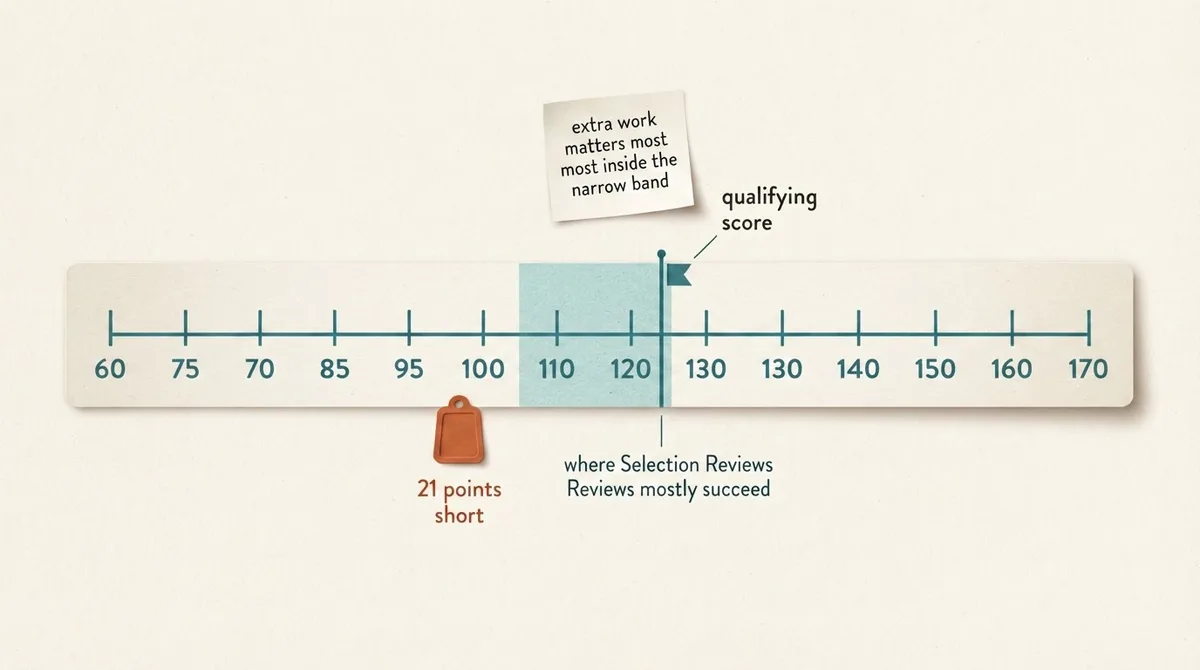
Buckinghamshire publishes something unusually candid about near misses. Its Selection Review guidance states: "historically most successful Selection Reviews have been for children whose score was between 110-120. Children with lower scores are rarely successful at Selection Review." Its appeals guidance adds that a child scoring 100, a 21-point shortfall against the 121 minimum, "is highly unlikely to succeed at appeal".
That gives parents something the SERP never provides: a map of where effort changes outcomes. There is a narrow band, roughly 110 to 120, where a child is genuinely borderline and where evidence and additional preparation can matter. Well below it, the realistic answer is that grammar entry is not the right route, and pushing harder mainly costs the child a year of their childhood.
The borderline is also noisier than it looks. Research cited by the campaign group Comprehensive Future points to Sutton Trust analysis finding around 22% of pupils misclassified when 11 plus outcomes are checked against eventual GCSE performance, and FFT Education Data Lab analysis finding 8% of children who passed were within one mark of failing. You cannot revise your way out of measurement error. If a single mark separates pass from fail for that many children, then a chunk of the outcome is chance, and treating the result as a verdict on a ten-year-old's ability is simply not supported.
Is it getting harder each year? Not systematically. Thresholds move because cohorts and papers vary, which is exactly why Tunbridge Wells Girls' notes that "the score threshold changes each year" and why Sutton refuses to publish a mark in advance. What has increased in many areas is the volume of preparation, which raises the felt difficulty without changing the underlying test.
What genuinely makes it hard for a ten-year-old?
Strip out the adult anxiety and the real difficulties are mundane.
- Pace. Most children can answer most questions. Far fewer can answer them at roughly one every 45 to 60 seconds without losing accuracy.
- Unfamiliar question types. Non-verbal reasoning in particular has no curriculum home, so the first encounter is pure novelty.
- Stamina. Two hour-long papers in a morning is longer than most primary children have ever concentrated on formal work.
- Emotional load. Children know the adults around them care about the result, and they are not good at separating a test outcome from a judgement of themselves.
- Single-sitting risk. One morning, one performance, in most areas no resit.
A worked example of the pace problem: a child who takes 90 seconds on each of the first ten questions has spent a quarter of the paper on a fifth of the marks, and will almost certainly leave easy questions unanswered at the end. That child does not need more content teaching. They need a rule for abandoning a question and moving on, which is a technique fix and takes weeks, not years.
How much preparation is enough?
Here the authorities offer an unexpectedly useful anchor. The Buckinghamshire Grammar Schools state that "familiarisation materials for the Buckinghamshire test are made available to parents in the summer term of Year 5". The body that runs the test scopes preparation to roughly one year. Nothing in the official guidance supports a three-year campaign beginning in Year 4.
A defensible workload ceiling looks like this:
- From summer of Year 5: short sessions, three to four times a week, 20 to 30 minutes, focused on familiarisation with each question type.
- Autumn and spring of Year 6 equivalent: the same frequency plus one timed full paper a fortnight, with the review of that paper counted as part of the workload rather than added to it.
- Final term before the test: hold the volume steady and shift entirely to timing, accuracy and calm. Do not increase hours.
- Always: at least two completely clear days a week with no 11 plus work at all.
Apply the threshold logic on top. If your child sits comfortably above the qualifying score in a threshold area, additional hours are, by the council's own admission rules, buying nothing. If the gap sits inside the 110 to 120 band, targeted work on the weakest paper is the highest-value thing available. If the gap is far larger, the kind thing is to change the plan, not intensify it.
Using progress tracking to see which question types are genuinely weak is what keeps this honest, because it stops families defaulting to "more of everything". Our year-by-year preparation plan sets out the same scope in more detail.
What are the warning signs of too much pressure?
Use a clinical checklist rather than instinct. The NHS guidance on helping your child beat exam stress points to changes worth acting on:
- sleeping badly, or waking early and worrying
- changes in appetite, or complaints of stomach aches and headaches with no other cause
- becoming unusually irritable, tearful or withdrawn
- losing interest in activities they previously enjoyed
- catastrophic talk about the exam or about themselves ("I'm going to ruin everything")
Any of these appearing and persisting is a signal to reduce workload immediately, not to negotiate a smaller reduction. Sleep, eating well and exercise are the interventions the NHS names first, and they are the ones families cut when a test approaches. If the signs persist after you have cut back, speak to your GP.
One quiet reframe helps enormously: tell your child, honestly, that the result partly depends on things nobody controls, including where you live and how many other children applied. That is not a comforting fiction. It is what the admission authorities publish.
When should you stop preparing?
Almost no page answers this, so here is a stop rule with three tests.
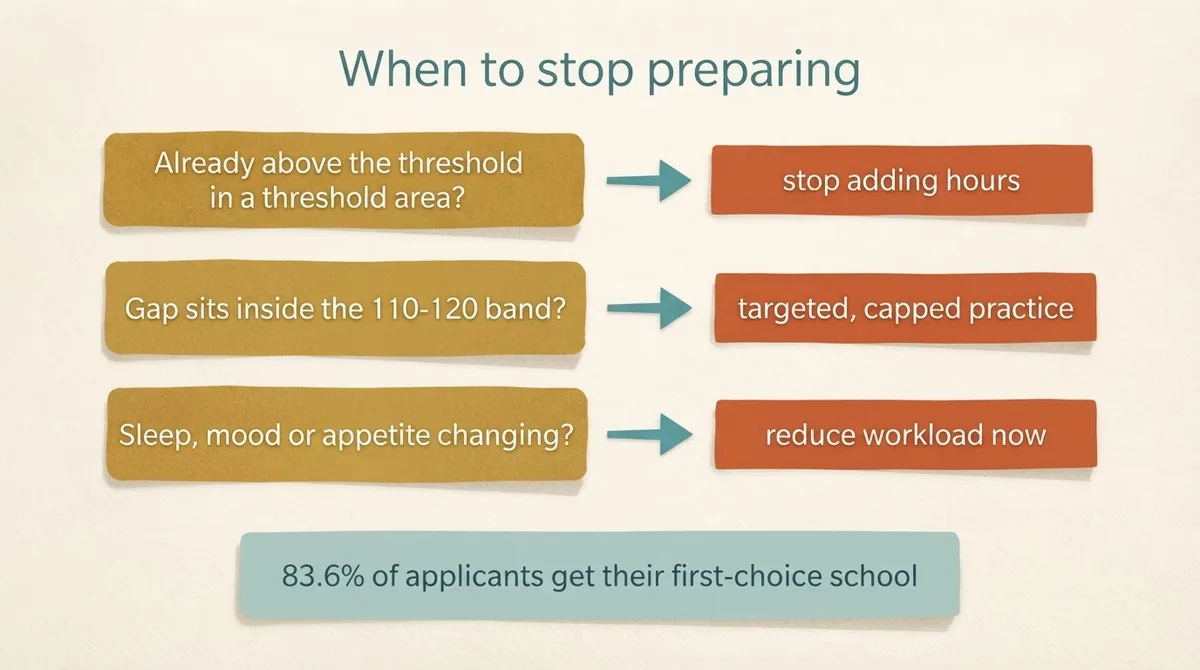
Stop adding work if you are already above threshold in a threshold area. Buckinghamshire has confirmed that score above 121 confers no priority. Consolidate and protect confidence instead.
Keep going, but narrowly, if the remaining gap sits inside 110 to 120. That is the band where Selection Reviews historically succeed, so improvement is both plausible and consequential. Work the weakest paper, cap the hours.
Stop if the warning signs appear and do not clear within a fortnight of reducing the load. No school place is worth a child who has learned to dread learning.
And then the figure that should sit under every one of these decisions. Department for Education statistics for 2026/27 entry show that 83.6% of secondary applicants received an offer of their first choice school, and 95.0% received an offer of one of their top three preferences (DfE, applications and offers). The overwhelming majority of families, including families whose child does not pass a selective test, get the school they asked for.
Is 70% enough to pass the 11 plus?
There is no reliable answer in percentage terms, because most authorities do not select on raw percentages. Buckinghamshire converts raw marks into an age-standardised score between 60 and 170 and qualifies children at 121, and Sutton does not fix its mark until after every paper is marked. A raw 70% could clear the bar in one year and fall short in another. Track standardised scores on practice papers, not percentages.
Does the 11 plus get harder every year?
Not in any documented, systematic way. Thresholds move with the cohort and the paper, which is why Kent schools state that the threshold changes each year. What has changed in many catchments is how much preparation is common, which increases the felt intensity around the exam without altering the test itself.
What percentage of pupils pass?
It depends entirely on the area. Buckinghamshire expects about 37% of its test-takers to reach 121. Super-selective schools are far tighter, because they rank rather than threshold. Any single national pass rate you see quoted is averaging over systems that do not resemble each other.
If they do not pass, what then?
Check whether your area has a review or appeal route and where your child's score sits relative to the reviewable band. Then focus on the preference list, because that is where 83.6% of families get the answer they wanted.
The honest answer
Is the 11 plus hard? The test is demanding, unfamiliar and fast, and children need real practice with the format to show what they can do. But the difficulty most families feel is not test difficulty. It is admission difficulty, which is decided by distance, siblings and cohort size, and which no amount of revision can influence.
Work out which system you are in before you decide how hard to push. If you are in a threshold area and your child is comfortably clear of the qualifying score, you have already finished the part you control. If you want structured, timed practice that shows where a child actually stands rather than encouraging more of everything, you can start with Trace Learn and use the data to decide when to stop.
Topics
- 11 plus
- difficulty
- exam pressure
- grammar schools
- pass marks