
Year 5 writing: The cottage beyond the bend
Connect a pictured setting to a character's purpose.
Your writing task
Look at the river and cottage illustration. Imagine that a child and an adult are arriving at the cottage to return a borrowed object. Write a story in which the object matters more than they expected. Use the landscape to support the story.
Look at the picture
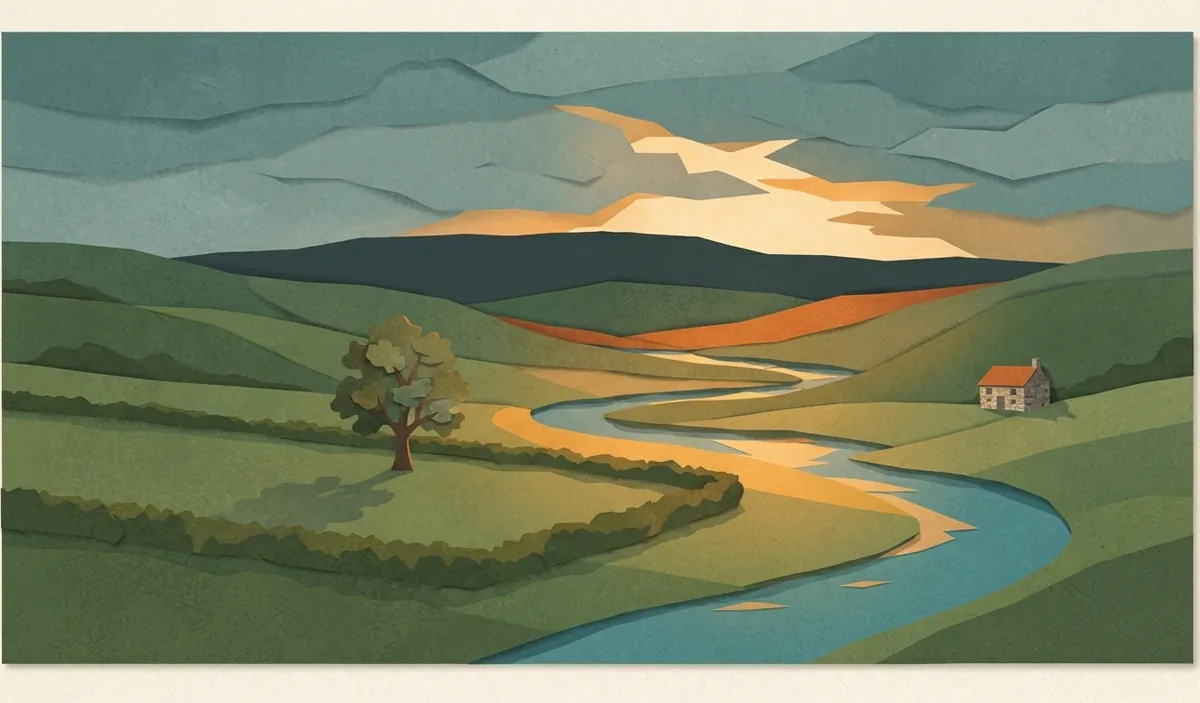
Plan before you write
- What are they returning, and to whom?
- How does the journey change what the child thinks about the object?
- What will the owner reveal when they arrive?
Write on paper or in your own document. Try a first draft before reading the model responses.
An opening you can try
From the path, the cottage looked small enough to fit inside a pocket.
Use this opening or write your own. A useful opening gives your reader something to follow.
A small word bank
- remote
- Far away from towns and hard to reach.
- horizon
- The distant line where the land or sea seems to meet the sky.
- recall
- To bring a memory back into your mind.
Choose a word only when its meaning fits. You do not need to use every word in the bank.
Build a learning plan
Create a parent account to organise your child's learning alongside these free writing activities.
Compare three model responses
These are three ways to develop the same task. They are teaching examples, with notes linked to the English national curriculum. They are not exam grades or a prediction of a mark.
A starting point
Lena and Dad followed the path beside the river. They were taking a small tin back to Aunt Jo at the cottage. Lena thought it was only an old biscuit tin.
At the door, Aunt Jo opened it carefully. Inside were letters from her brother, who lived far away. She read one line aloud and smiled. Lena held the lid for her. She understood why Dad had carried the tin so carefully.
Teaching notes
Choose useful details and words
Lena held the lid for her.
The small action shows that Lena treats the tin differently after learning what it contains.
Organise related ideas
only an old biscuit tin
The opening belief sets up the change at the end.
Try next: Describe one landscape detail that makes the journey feel long or quiet.
A more developed response
From the path, the cottage looked small enough to fit inside a pocket. Lena and Dad followed the river round the bend, carrying Aunt Jo's old biscuit tin. Dad had borrowed it to keep some letters dry while a cupboard was repaired.
Lena wondered why the dented tin mattered. As they walked, Dad told her that the letters were from Aunt Jo's brother. He had written about places beyond the hills Lena could see.
At the cottage, Aunt Jo lifted the lid and found a letter tied with blue string. She read a line about a windy harbour. For a moment, the remote house seemed connected to somewhere much larger. Lena sat beside her and asked to hear the next line.
Teaching notes
Choose useful details and words
places beyond the hills Lena could see
The landscape becomes part of Lena's understanding, rather than decoration.
Write for a reader and purpose
asked to hear the next line
The ending shows the child's new interest through a choice.
Try next: Make the reason for borrowing and returning the tin clear in one sentence.
A further developed response
From the path, the cottage looked small enough to fit inside a pocket. The river curved towards it, catching the last pale light beneath a bank of clouds. Lena walked beside Dad, watching the old biscuit tin in his hands.
He had borrowed it while Aunt Jo's cupboard was repaired. Lena could not understand why he carried a dented tin as though it were fragile glass. Then Dad explained what was inside: letters from Aunt Jo's brother, written during years away from home.
The hills closed the horizon around them. Lena tried to imagine the places beyond it. She had thought of the cottage as remote, but perhaps its kitchen was full of voices from elsewhere.
Aunt Jo met them at the door. She chose a letter tied with faded blue string and began to read about a windy harbour. When she paused to recall the name of a boat, Lena waited instead of looking at the clock.
Outside, the river kept turning towards the hills. Inside, Lena asked if she could hear another letter.
Teaching notes
Choose useful details and words
its kitchen was full of voices from elsewhere
The imagined voices connect the remote setting with the letters and the owner's memories.
Organise related ideas
Lena waited instead of looking at the clock.
The action shows a shift in attention before the final request confirms it.
Try next: Read the final paragraph and check that it completes Lena's change in attitude.
Read back and improve
- Does the setting affect how the child thinks?
- Have you explained what the object means to its owner?
- Check that an adult remains part of the imagined journey.
Where the teaching notes come from
Our notes apply the published writing guidance for Years 3 and 4 and Years 5 and 6. The prompts and model responses were written originally for Trace Learn. Reviewed 2026-10-01.
Read the Department for Education English curriculumChoose another writing task
Questions parents ask
What should I plan before I write?
What are they returning, and to whom? How does the journey change what the child thinks about the object? What will the owner reveal when they arrive?
How can I improve my first draft?
Does the setting affect how the child thinks? Have you explained what the object means to its owner? Check that an adult remains part of the imagined journey.
Will this page mark or save my writing?
No. Write on paper or in your own document. The models and notes are teaching examples. This page does not collect your writing, save it to a profile or award a score.
Find topics to practise next
The free diagnostic checks maths, English and both kinds of reasoning. Use it to explore the skills your child could practise alongside writing.