
Year 4 writing: The notebook's new owner
Use an illustration to begin an original story.
Your writing task
Look at the desk picture. Imagine that the blank notebook has just been given to a new owner. Write a story about what they decide to put on its first page. Use a detail from the picture, but invent your own events.
Look at the picture
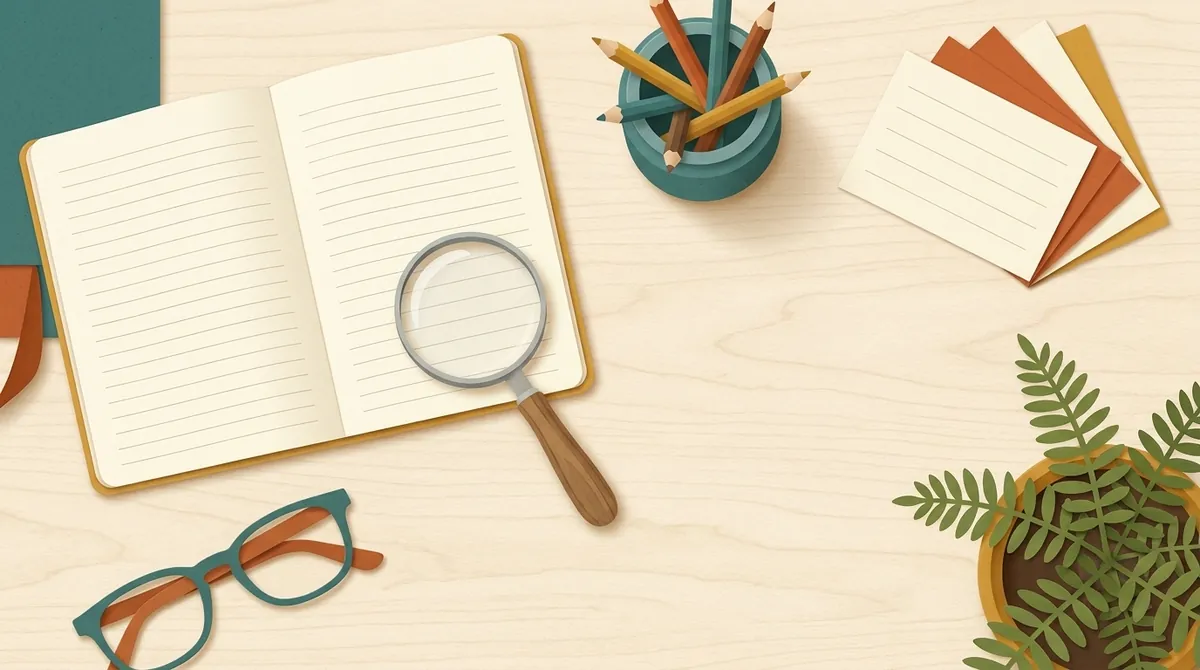
Plan before you write
- Who gives the notebook to its new owner?
- Which object in the picture helps the owner choose an idea?
- What does the first page look like at the end?
Write on paper or in your own document. Try a first draft before reading the model responses.
An opening you can try
The first page was waiting, but Eli was not sure what to write.
Use this opening or write your own. A useful opening gives your reader something to follow.
A small word bank
- hesitate
- To pause before doing something because you are unsure or nervous.
- peculiar
- Describing something strange or odd, unlike what you would usually expect.
- genuine
- Real, and exactly what it claims to be.
Choose a word only when its meaning fits. You do not need to use every word in the bank.
Build a learning plan
Create a parent account to organise your child's learning alongside these free writing activities.
Compare three model responses
These are three ways to develop the same task. They are teaching examples, with notes linked to the English national curriculum. They are not exam grades or a prediction of a mark.
A starting point
Eli opened the new notebook. Its pages were blank. He wanted to write something good, but he could not think of anything. He picked up a pencil and put it down again.
Then he noticed the plant on the desk. One leaf was smaller than the others. Eli drew it and wrote three things he could see. He decided the notebook could be a place for small discoveries, starting with that leaf.
Teaching notes
Choose useful details and words
One leaf was smaller
A visible detail gives the character an idea instead of the idea appearing without a cause.
Organise related ideas
starting with that leaf
The ending connects the purpose of the notebook to the detail that inspired it.
Try next: Use another object from the picture to help Eli look more closely.
A more developed response
The first page was waiting, but Eli was not sure what to write. His aunt had given him the notebook that morning. He wanted its first page to be important, so he had crossed out nothing and written nothing.
A magnifying glass lay beside the pencils. Eli held it over a fern leaf and noticed a tiny brown edge he had never seen before. He drew the leaf, then added a question: 'Why is this part different?'
The page did not look like the beginning of a grand adventure. It looked like a question he might answer tomorrow. Eli turned the pencil in his fingers and began a second drawing.
Teaching notes
Choose useful details and words
A magnifying glass lay beside the pencils.
The model uses an object actually visible in the stimulus to move the story forward.
Write for a reader and purpose
a question he might answer tomorrow
The notebook's new purpose gives the story an ending and room for a future event.
Try next: Add a short action that shows Eli becoming less hesitant.
A further developed response
The first page was waiting, but Eli was not sure what to write. His aunt had called it a notebook for discoveries. That sounded important. So far, his only discovery was that a blank page could make him hesitate for a very long time.
He moved the magnifying glass over the fern beside the desk. Through the lens, a leaf edge looked like a row of tiny teeth. A peculiar brown patch interrupted the green. Eli had passed this plant every day without noticing either detail.
He drew the leaf slowly, then wrote a question beneath it. He did not know the answer yet. That bothered him until he remembered that a discovery could begin with not knowing.
By lunchtime, the page held one drawing, two questions and a small smudge where his hand had touched the pencil. It was not perfect. It was a genuine start. Eli closed the notebook carefully and left the magnifying glass on top, ready for tomorrow.
Teaching notes
Choose useful details and words
a small smudge
The model makes the finished page believable rather than presenting a flawless drawing.
Organise related ideas
ready for tomorrow
The ending shows a change from hesitation to a plan for continued use.
Try next: Check which details come from the picture and which are your own invention.
Read back and improve
- Have you used at least one visible object from the picture?
- Does the new owner make a choice that changes the page?
- Keep invented events clear without claiming the picture shows them.
Where the teaching notes come from
Our notes apply the published writing guidance for Years 3 and 4 and Years 5 and 6. The prompts and model responses were written originally for Trace Learn. Reviewed 2026-10-01.
Read the Department for Education English curriculumChoose another writing task
Questions parents ask
What should I plan before I write?
Who gives the notebook to its new owner? Which object in the picture helps the owner choose an idea? What does the first page look like at the end?
How can I improve my first draft?
Have you used at least one visible object from the picture? Does the new owner make a choice that changes the page? Keep invented events clear without claiming the picture shows them.
Will this page mark or save my writing?
No. Write on paper or in your own document. The models and notes are teaching examples. This page does not collect your writing, save it to a profile or award a score.
Find topics to practise next
The free diagnostic checks maths, English and both kinds of reasoning. Use it to explore the skills your child could practise alongside writing.